Introduction
When selecting industrial flooring, one of the first questions engineers and project managers ask is about fiberglass grating weight. Understanding how much FRP grating weighs per square foot directly impacts structural design, shipping logistics, installation labor, and overall project costs. Unlike steel or aluminum alternatives, fiberglass reinforced plastic grating offers a unique balance of light weight and high strength that makes it ideal for platforms, walkways, and catwalks in demanding environments.
This complete reference guide provides everything you need to know about fiberglass grating panels weight, including detailed weight-per-square-foot tables for both molded and pultruded types, comparisons with steel and aluminum, load capacity implications, and practical formulas for calculating shipping weights. Whether you are specifying grating for a chemical plant, offshore platform, or water treatment facility, this guide will help you make informed decisions.
Throughout this article, we address common questions such as how much fiberglass grating weighs per square foot, how its weight compares to steel and aluminum, and how weight relates to load-bearing performance. By the end, you will have a complete understanding of fiberglass grating weight specifications and their practical implications.
What Is Fiberglass Grating Weight?
Fiberglass grating weight refers to the mass per unit area or per panel of fiberglass reinforced plastic (FRP) grating products. Unlike steel grating, which has a consistent density based on its all-metal construction, fiberglass grating weight varies depending on the manufacturing method, resin type, glass content, and panel design.
Fiberglass grating panels weight is typically expressed in pounds per square foot (psf) or kilograms per square meter (kg/m²). Most manufacturers provide weight specifications for standard panel sizes such as 4 ft × 8 ft, 4 ft × 12 ft, or 1 m × 4 m panels. Understanding these values is essential for structural engineers calculating dead loads on support beams and for logistics teams planning freight shipments.
Standard Fiberglass Grating Panel Weight Ranges
The typical weight of a standard fiberglass grating panel falls within these general ranges depending on type and thickness:
- Molded fiberglass grating (1-inch thickness): 3.5 – 4.5 psf (17 – 22 kg/m²)
- Molded fiberglass grating (1.5-inch thickness): 5.0 – 6.5 psf (24 – 32 kg/m²)
- Pultruded fiberglass grating (1-inch thickness): 2.5 – 3.5 psf (12 – 17 kg/m²)
- Pultruded fiberglass grating (1.5-inch thickness): 4.0 – 5.5 psf (20 – 27 kg/m²)
- Pultruded fiberglass grating (2-inch thickness): 5.5 – 7.5 psf (27 – 37 kg/m²)
A standard 4 ft × 8 ft (32 sq ft) panel of 1-inch molded grating typically weighs between 112 and 144 lbs total, while a comparable pultruded panel weighs 80 to 112 lbs. These ranges make fiberglass grating significantly lighter than steel grating, which can weigh 10–20 psf or more depending on the bar size and spacing.
Several factors influence the final weight of a fiberglass grating panel:
- Resin type: Vinyl ester, polyester, and phenolic resins have slightly different densities
- Glass content: Higher glass-to-resin ratios increase strength but also add weight
- Mesh configuration: Molded grating with more glass strands per inch is heavier
- Surface finish: Gritted or coated surfaces add minimal weight (0.1–0.3 psf)
Fiberglass Grating Weight Per Square Foot — Reference Table
Below is a comprehensive reference table showing fiberglass grating weight per square foot for the most common panel configurations. These values represent industry-standard data from major FRP grating manufacturers and are based on standard polyester resin formulations with approximately 65% glass content.
| Type | Thickness | Mesh / Bearing Bar | Weight (psf) | Weight (kg/m²) | Standard Panel Weight (4×8') |
|---|---|---|---|---|---|
| Molded | 1" (25 mm) | 1.5" × 1.5" mesh | 4.0 psf | 19.5 kg/m² | 128 lbs (58 kg) |
| 1.5" (38 mm) | 1.5" × 1.5" mesh | 5.8 psf | 28.3 kg/m² | 186 lbs (84 kg) | |
| 2" (50 mm) | 1.5" × 1.5" mesh | 7.5 psf | 36.6 kg/m² | 240 lbs (109 kg) | |
| Pultruded | 1" (25 mm) | I-bar 1/4" × 1" | 2.8 psf | 13.7 kg/m² | 90 lbs (41 kg) |
| 1.5" (38 mm) | I-bar 3/8" × 1.5" | 4.5 psf | 22.0 kg/m² | 144 lbs (65 kg) | |
| 2" (50 mm) | I-bar 3/8" × 2" | 6.0 psf | 29.3 kg/m² | 192 lbs (87 kg) | |
| 2.5" (64 mm) | I-bar 1/2" × 2.5" | 7.5 psf | 36.6 kg/m² | 240 lbs (109 kg) |
How Much Does Fiberglass Grating Weigh Per Square Foot?
To directly answer the most common question: fiberglass grating weight per square foot ranges from approximately 2.8 psf for lightweight pultruded 1-inch grating to 7.5 psf for heavy-duty 2-inch molded or 2.5-inch pultruded grating. The average 1-inch molded grating weighs around 4.0 psf, while the average 1-inch pultruded grating weighs about 2.8 psf — roughly 30% lighter than its molded counterpart at the same thickness.
Molded Fiberglass Grating Weight Details
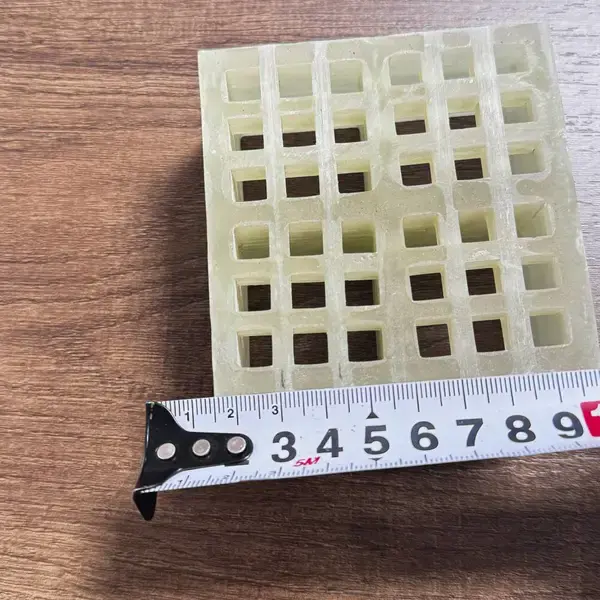
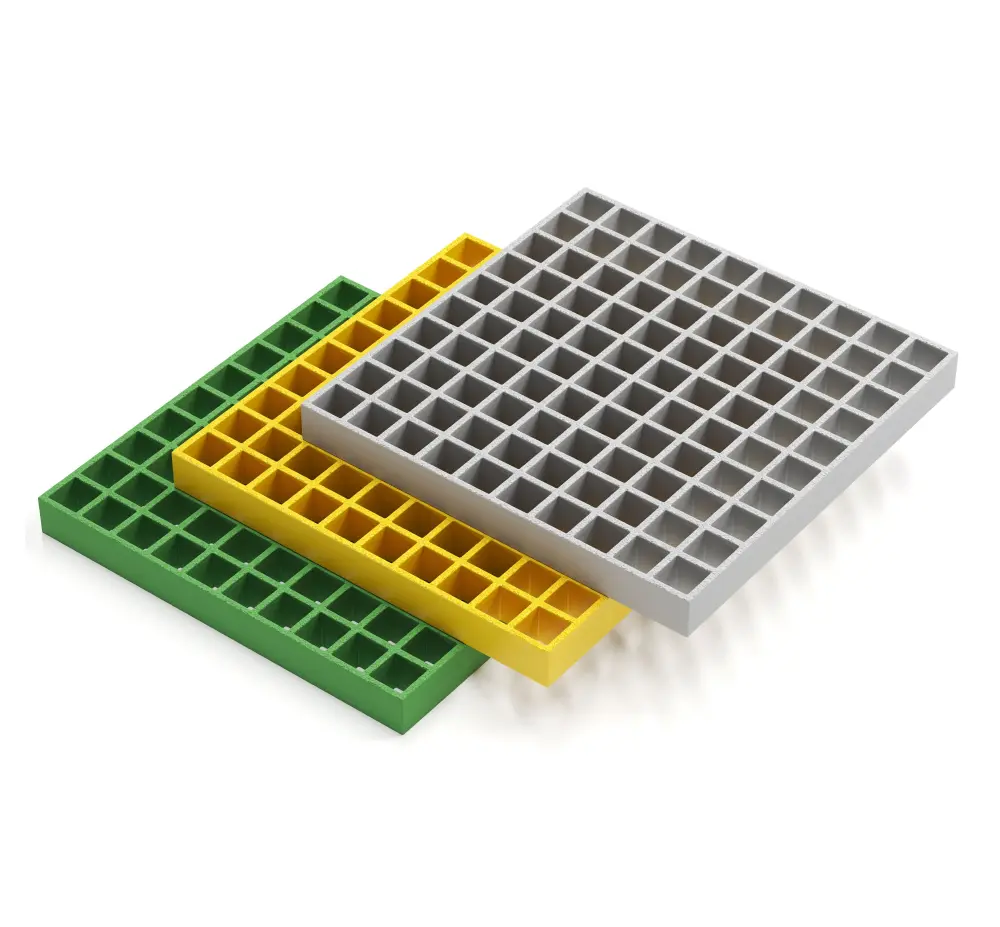
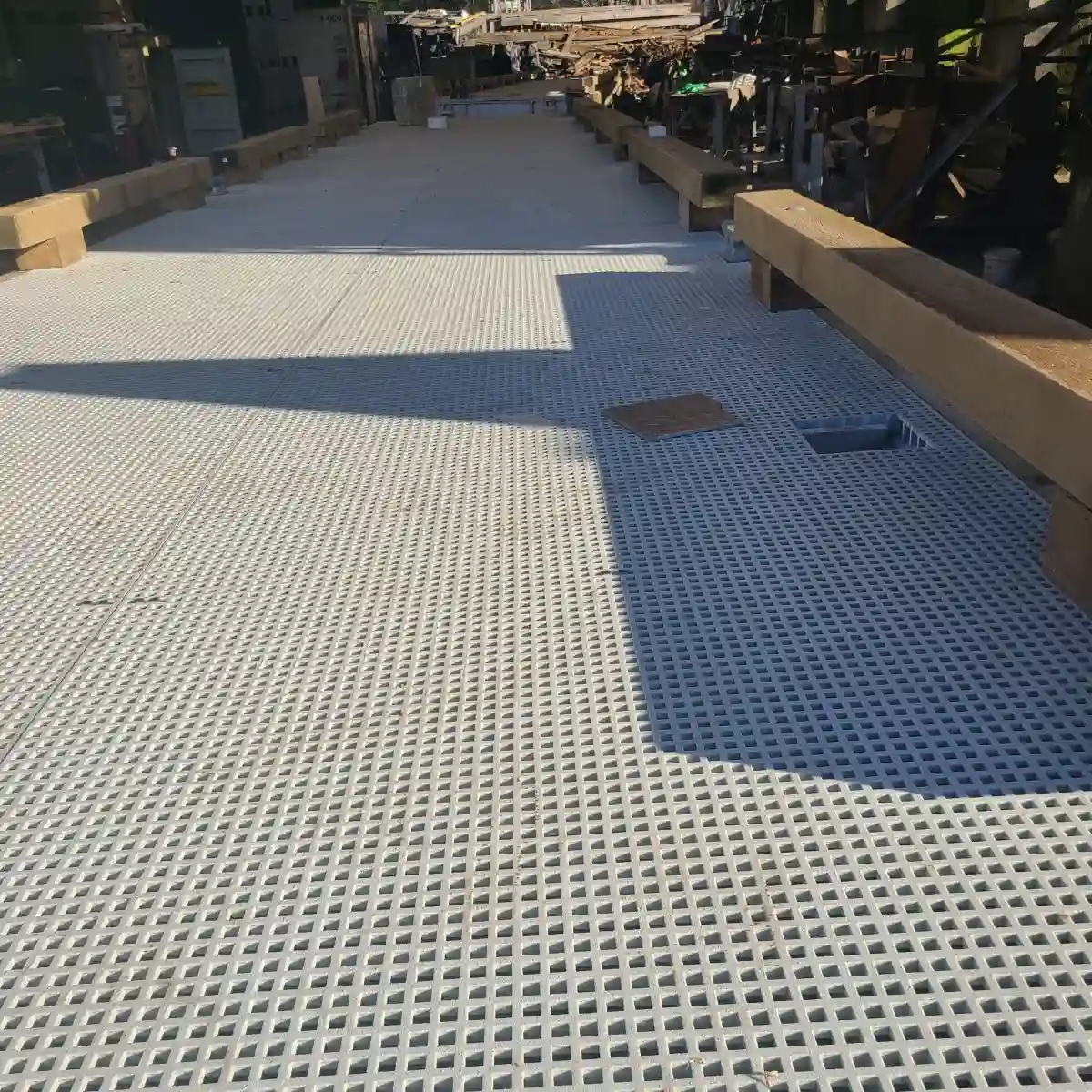
Molded fiberglass grating is manufactured in a compression molding process that creates a square mesh pattern. The resulting fiberglass grating panels weight is distributed evenly across the entire panel because the glass strands are interwoven in both directions. Standard molded grating panels typically have a 1.5" × 1.5" mesh pattern with thickness options of 1", 1.5", and 2". The weight increases proportionally with thickness due to the additional glass and resin material.
Pultruded Fiberglass Grating Weight Details
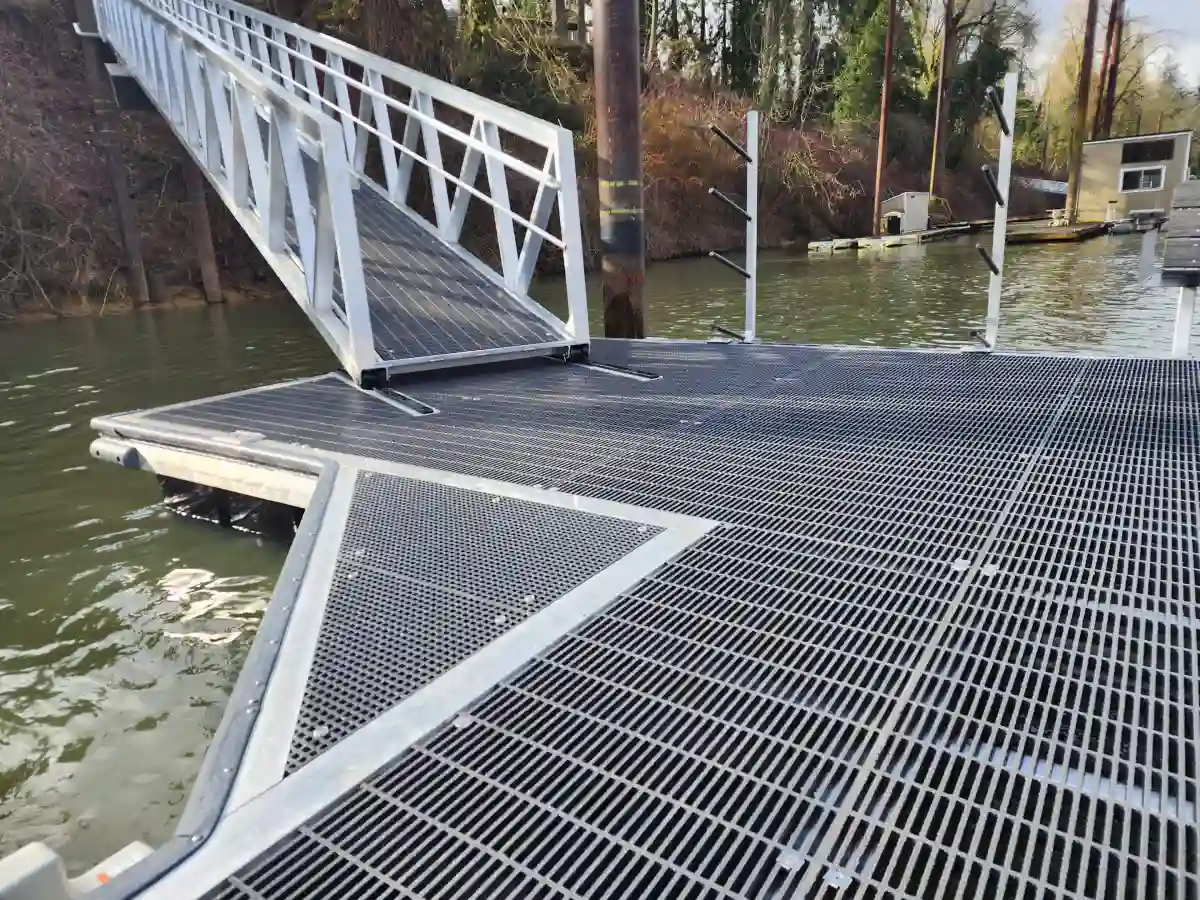
Pultruded fiberglass grating uses continuous I-beam or T-bar bearing bars with cross rods for structural integrity. Because the material is concentrated in the bearing bars rather than spread across a mesh, pultruded grating achieves lower weight per square foot while maintaining high strength in the bar direction. This makes pultruded grating an excellent choice for applications requiring both light weight and high load capacity in one direction.
Molded vs Pultruded Fiberglass Grating Weight Comparison
One of the most important considerations when selecting FRP grating is understanding how the weight of molded vs pultruded fiberglass grating compares. These two manufacturing processes produce distinctly different products, each with unique weight characteristics that affect their suitability for different applications.
Molded Grating Weight Profile
Molded fiberglass grating is produced by stacking alternating layers of continuous glass strand mats and resin in a heated press. This creates a uniform square mesh pattern with consistent weight distribution across the entire panel. The interwoven construction means molded grating has more total glass content per square foot compared to pultruded grating at the same nominal thickness. As a result, fiberglass grating weight for molded types is typically 30–40% higher than pultruded types of the same thickness.
For example, a 1-inch thick molded grating panel weighs approximately 4.0 psf, while a 1-inch pultruded panel weighs only about 2.8 psf. This weight difference is significant when calculating total dead loads for a large platform installation. However, the additional weight in molded grating comes with benefits: the bidirectional strength distribution makes it ideal for applications where loads may come from any direction.
Pultruded Grating Weight Profile
Pultruded fiberglass grating is manufactured by pulling continuous glass fibers through a resin bath and then through a heated die. The resulting bearing bars are shaped like I-beams or T-bars, with cross rods passing through them at regular intervals. This design concentrates material where it is structurally needed, resulting in a lighter product that still delivers excellent load-bearing capacity in the direction of the bearing bars.
A 1.5-inch pultruded grating panel weighs about 4.5 psf compared to 5.8 psf for molded grating at the same thickness — a saving of approximately 22%. For a large installation with 500 panels, this weight difference can translate to tens of thousands of pounds in total structural load reduction. Pultruded grating also tends to have a higher strength-to-weight ratio, making it the preferred choice for long-span applications.
Side-by-Side Comparison
| Thickness | Molded Weight | Pultruded Weight | Weight Savings |
|---|---|---|---|
| 1" (25 mm) | 4.0 psf | 2.8 psf | 30% lighter |
| 1.5" (38 mm) | 5.8 psf | 4.5 psf | 22% lighter |
| 2" (50 mm) | 7.5 psf | 6.0 psf | 20% lighter |
In summary, fiberglass grating weight comparison between molded and pultruded types shows that pultruded grating is consistently lighter at every thickness level. The weight difference is most pronounced at thinner profiles and narrows slightly as thickness increases. Your choice should be guided by the specific load requirements of your application — molded for multi-directional loading and pultruded for long-span, single-direction applications where weight savings are critical.
' --status final 2>&1Fiberglass Grating vs Steel vs Aluminum — Weight Comparison
When specifying industrial flooring, engineers commonly compare fiberglass grating against traditional materials like steel and aluminum. The fiberglass grating weight advantage is one of the most compelling reasons to choose FRP over metal alternatives. Here we provide a detailed weight comparison across these three materials at standard configurations.
Fiberglass vs Steel Grating Weight
Steel grating is significantly heavier than fiberglass grating at equivalent load ratings. A standard steel grating panel with 1/4" × 1" bearing bars at 4" centers weighs approximately 10–12 psf, while a fiberglass grating panel with comparable load capacity weighs only 3–5 psf. This means fiberglass grating is typically 60–70% lighter than steel grating for equivalent performance.
For a 100 ft × 4 ft walkway (400 sq ft), steel grating would add approximately 4,000–4,800 lbs of dead load to the support structure, while fiberglass grating would add only 1,200–2,000 lbs. This dramatic weight reduction translates directly into savings on structural steel, foundation requirements, and installation labor. Additionally, the lighter weight of fiberglass grating makes it possible to install grating in locations where heavy steel grating would require crane lifting equipment.
Is Fiberglass Grating Lighter Than Aluminum Grating?
This is a common question, and the answer depends on the specific configurations being compared. Aluminum grating typically weighs between 3.0 and 6.0 psf depending on bar size and spacing. Standard 1-inch fiberglass grating (molded, 4.0 psf) is comparable in weight to light-duty aluminum grating (approximately 3.5 psf). However, for equivalent load capacity, fiberglass grating is generally lighter than aluminum grating because fiberglass has a higher strength-to-weight ratio.
For heavy-duty applications where aluminum grating requires thicker bars to achieve the necessary load rating, fiberglass grating can be up to 20–30% lighter than the aluminum equivalent. Additionally, fiberglass does not corrode like aluminum in certain chemical environments, making it the superior choice despite the similar weight profile.
Material Density Comparison
| Material | Density (lb/in³) | Typical Grating Weight (psf) | Relative Weight vs FRP |
|---|---|---|---|
| Fiberglass (FRP) | 0.062 – 0.072 | 2.8 – 7.5 psf | Baseline |
| Aluminum (6061-T6) | 0.098 | 3.0 – 8.0 psf | 10–40% heavier |
| Steel (A36) | 0.284 | 8.0 – 20+ psf | 100–400% heavier |
The material density comparison clearly shows why fiberglass grating is the lightest option among these three common industrial flooring materials. The fiberglass grating vs steel weight advantage is particularly pronounced, making FRP the go-to choice for weight-sensitive applications such as offshore platforms, elevated walkways, and rooftop installations.
' --status final 2>&1How Fiberglass Grating Weight Affects Load Capacity
Understanding the relationship between fiberglass grating weight and load capacity is critical for safe structural design. While it is true that heavier grating panels generally offer higher load capacities, the correlation is not linear and depends on several factors including the manufacturing method, bearing bar design, and span configuration.
Does Fiberglass Grating Weight Affect Its Load Capacity?
Yes, fiberglass grating weight does affect its load capacity — but not in the same way it does for steel grating. In steel grating, load capacity is directly proportional to the cross-sectional area of the bearing bars (which determines weight). In fiberglass grating, the strength-to-weight ratio is much higher because the glass fibers carry the load while the resin matrix provides shape and environmental protection.
A lightweight fiberglass grating panel (such as 1-inch pultruded at 2.8 psf) can support concentrated loads of 300–500 lbs per square foot at a 12-inch span, while a heavier molded panel (1.5-inch at 5.8 psf) might support 800–1,200 lbs per square foot at the same span. The heavier panel supports more weight, but the strength-to-weight ratio of fiberglass is approximately 3–4 times better than steel and 1.5–2 times better than aluminum.
How Much Weight Can Fiberglass Grating Support Per Square Foot?
The load capacity of fiberglass grating varies significantly based on panel type, thickness, and support span. Here are typical uniform load capacities at a 12-inch support span:
| Grating Type | Thickness | Weight (psf) | Uniform Load Capacity (psf) | Concentrated Load (lbs) |
|---|---|---|---|---|
| Pultruded | 1" | 2.8 | 400 psf | 500 lbs |
| Pultruded | 1.5" | 4.5 | 800 psf | 1,000 lbs |
| Pultruded | 2" | 6.0 | 1,200 psf | 1,500 lbs |
| Molded | 1" | 4.0 | 500 psf | 600 lbs |
| Molded | 1.5" | 5.8 | 1,000 psf | 1,200 lbs |
| Molded | 2" | 7.5 | 1,500 psf | 2,000 lbs |
As the table shows, heavier grating panels do support higher loads, but the increase in load capacity is proportionally greater than the increase in weight. For example, upgrading from 1" pultruded (2.8 psf) to 1.5" pultruded (4.5 psf) increases weight by 60% but doubles the load capacity from 400 psf to 800 psf. This excellent strength-to-weight ratio is what makes fiberglass grating load capacity so impressive for lightweight industrial flooring.
Load Capacity of Lightweight Fiberglass Grating
Lightweight fiberglass grating — typically 1-inch pultruded panels weighing 2.5–3.0 psf — is perfectly suitable for pedestrian walkways, maintenance platforms, and light industrial applications. At spans of 12–18 inches, these panels easily support concentrated loads of 300–500 lbs, which covers most walking and maintenance traffic. For heavy vehicle traffic or equipment support, thicker panels with higher weight ratings are recommended.
' --status final 2>&1How to Calculate Fiberglass Grating Weight for Shipping
Calculating fiberglass grating weight for shipping purposes is straightforward once you know the weight per square foot of the specific grating type. Accurate weight calculations are essential for determining freight costs, selecting the right shipping method, and ensuring that transport vehicles are not overloaded.
Basic Weight Calculation Formula
The simplest method to calculate fiberglass grating weight for shipping is:
Total Weight = Panel Area (sq ft) × Weight per Square Foot (psf) × Number of Panels
For example, if you are shipping 50 panels of 1-inch molded grating (4.0 psf) in standard 4 ft × 8 ft size:
- Panel area: 4 × 8 = 32 sq ft
- Weight per panel: 32 × 4.0 = 128 lbs
- Total weight: 128 × 50 = 6,400 lbs (2,903 kg)
Factors to Include in Shipping Weight Calculations
When calculating fiberglass grating weight for shipping, remember to account for these additional factors:
- Packaging material: Wood crates, strapping, and protective wrapping add 2–5% to the total weight
- Pallet weight: Standard wooden pallets weigh 30–50 lbs each
- Moisture content: Fiberglass grating does not absorb moisture, but surface water from rain or washing can add temporary weight
- Cut pieces and waste: Include a 5–10% margin for off-cuts and scrap if shipping partially fabricated pieces
Sample Shipping Weight Calculations by Grating Type
| Grating Type | Panel Size | Weight (psf) | Per Panel | 50 Panels (palletized) |
|---|---|---|---|---|
| 1" Pultruded | 4 × 8 ft | 2.8 psf | 90 lbs | 4,750 lbs |
| 1" Molded | 4 × 8 ft | 4.0 psf | 128 lbs | 6,650 lbs |
| 1.5" Pultruded | 4 × 8 ft | 4.5 psf | 144 lbs | 7,450 lbs |
| 1.5" Molded | 4 × 8 ft | 5.8 psf | 186 lbs | 9,550 lbs |
| 2" Pultruded | 4 × 8 ft | 6.0 psf | 192 lbs | 9,850 lbs |
Note: Palletized weights include 50 lbs average pallet weight and 5% packaging allowance.
Volume Calculation for Air Freight
For air freight, dimensional weight may apply. Calculate the volumetric weight by multiplying panel dimensions (length × width × height in inches) and dividing by 166 (for domestic) or 139 (for international). Compare this to actual weight — the higher value determines the shipping cost. Fiberglass grating panels are relatively flat and stack efficiently, so actual weight typically determines the freight cost for ground shipping, while dimensional weight may apply for air shipments.
' --status final 2>&1Installation Benefits of Lightweight Fiberglass Grating
The lightweight nature of fiberglass grating provides significant installation advantages over traditional metal grating. Because fiberglass grating weight is 60–70% less than steel and comparable to or lighter than aluminum, installation crews can handle panels manually without requiring heavy lifting equipment in most cases.
Is Fiberglass Grating Easier to Install Due to Its Light Weight?
Yes, absolutely. The light weight of fiberglass grating directly translates to faster, safer, and more cost-effective installation. Here are the key benefits:
- No crane required: A standard 4 ft × 8 ft panel of 1-inch molded grating weighs only 128 lbs — easily maneuverable by two workers. Steel grating of the same size would weigh 300–400 lbs, requiring a crane or forklift for placement.
- Faster installation rates: Installation crews can typically place 30–50% more square footage per day with fiberglass grating compared to steel grating, reducing labor costs significantly.
- Reduced structural requirements: The lower dead load of fiberglass grating means lighter support beams, fewer columns, and simpler foundations — all of which speed up the overall construction schedule.
- Easier field modification: Fiberglass grating can be cut on-site with standard carbide-tipped saws. The light weight makes it easy to maneuver cut pieces into position, even in tight or elevated spaces.
- Safer handling: The reduced weight minimizes the risk of lifting injuries and makes it possible to install grating in locations that are inaccessible to heavy equipment, such as elevated platforms in existing structures.
Installation Labor Comparison
| Factor | Fiberglass Grating | Steel Grating | Benefit |
|---|---|---|---|
| Panel weight (4×8') | 90–186 lbs | 300–500 lbs | 50–70% lighter |
| Workers per panel | 2 workers | 3–4 workers or crane | Fewer crew needed |
| Cutting tools | Carbide saw blade | Plasma cutter or abrasive saw | Faster cuts, no sparks |
| Fastening method | Clip or through-bolt | Weld or heavy clip | No hot work permit needed |
| Avg. installation rate | 400–600 sq ft/day | 250–400 sq ft/day | 30–50% faster |
The combination of light weight, ease of cutting, and simple fastening makes fiberglass grating the most installer-friendly industrial flooring option available. Projects that would require weeks of steel grating installation can often be completed in days with fiberglass, directly reducing labor costs and project timelines. Additionally, because fiberglass grating does not require hot work for cutting or welding, it can be installed in hazardous environments where spark-producing tools are prohibited.
' --status final 2>&1Conclusion
Understanding fiberglass grating weight is essential for specifying the right product for any industrial flooring application. As this guide has shown, FRP grating offers a remarkable combination of light weight and high strength that outperforms traditional materials in most weight-sensitive installations.
To recap the key points:
- Fiberglass grating weight per square foot ranges from 2.8 psf for lightweight 1-inch pultruded panels to 7.5 psf for heavy-duty 2-inch molded or 2.5-inch pultruded panels.
- Pultruded fiberglass grating is consistently 20–30% lighter than molded grating at the same thickness, offering a higher strength-to-weight ratio for single-direction load applications.
- Compared to steel, fiberglass grating is 60–70% lighter at equivalent load ratings. Compared to aluminum, fiberglass is similar or lighter for equivalent load capacity.
- The fiberglass grating load capacity ranges from 400 psf for lightweight pultruded panels at 12-inch spans to over 1,500 psf for heavy-duty molded panels.
- Calculating shipping weight is simple using the area × psf formula, with allowances for packaging and pallets.
- The light weight of fiberglass grating significantly simplifies installation, reducing labor costs and project timelines while improving worker safety.
When selecting fiberglass grating for your next project, always consult the manufacturer's load tables for precise weight and load capacity data specific to the product you are specifying. Weight can vary between manufacturers due to differences in resin formulations, glass content, and manufacturing processes.
For additional information on fiberglass grating specifications, load tables, and installation guidelines, explore our related articles on FRP grating types and applications. If you need assistance selecting the right grating for your specific weight and load requirements, contact our technical team for personalized guidance.
' --status final 2>&1