Choosing an FRP grating manufacturer is not like ordering a commodity. The wrong supplier can cost your project months of delay, thousands in rework, and — in the worst case — a structural failure that puts people at risk.
This guide is built to prevent exactly that scenario. You will learn: the 7 certifications every legitimate FRP grating manufacturer must hold, a factory audit checklist you can use before placing a purchase order, the difference between factory-direct and distributor pricing, 10 questions that expose unreliable suppliers within minutes, and the red flags that signal you should walk away. Every recommendation is based on 15+ years of ISO 9001:2015 certified manufacturing, 500+ completed projects, and export to 50+ countries across six continents.
Already familiar with FRP grating types? See our complete FRP grating buyer's guide for technical specifications.
7 Certifications Every FRP Grating Manufacturer Should Have

Certifications are not optional — they are the baseline proof that a supplier follows documented quality processes, tests their products to published standards, and can be held accountable. Here are the seven you must verify before signing a purchase order:
- 1. ISO 9001:2015 — Quality Management System
The global standard. An ISO 9001:2015 certificate means documented raw material inspection, production control, finished goods testing, and corrective action. Ask to see the certificate and verify it with the issuing body''s online database. FRP Grating Pro''s certificate is available for download on request.
- 2. ASTM E84 — Surface Burning (Fire Rating)
Class 1 Flame Spread Index ≤ 25. Required for occupied buildings, chemical plants, and offshore platforms. Without it, your grating may fail a building inspection. All FRP Grating Pro panels meet ASTM E84 Class 1 as standard.
- 3. ASTM D635 — Rate of Burning
Measures self-extinguishing characteristics. Critical for environments where fire propagation risk must be minimized. Our vinyl ester and phenolic formulations exceed ASTM D635 requirements.
- 4. ANSI/NAAMM MBG 531 — Molded FRP Grating Standard
The definitive North American standard. Specifies minimum load capacity, deflection limits, dimensional tolerances, and resin content. A manufacturer who cannot reference MBG 531 by clause number is likely a reseller, not a manufacturer.
- 5. EN 13706 — European Pultruded Profiles
Required for FRP grating exported to the EU. If your manufacturer claims EU exports but cannot produce EN 13706 documentation — red flag.
- 6. OSHA 1910.22 / 1910.24 — Walking-Working Surfaces
Mandatory for US workplaces. The manufacturer must provide load rating documentation demonstrating OSHA compliance for your specific span and loading condition.
- 7. ADA Compliance — Mesh ≤ ½ inch for Accessible Routes
If your installation falls on an accessible route, ADA requires mesh openings ≤ ½ inch in the direction of travel. A competent manufacturer flags this during quoting — not after installation fails inspection.
Factory Audit Checklist: What to Verify Before You Order
You do not need to be an FRP grating engineer to conduct a meaningful factory audit — you need a checklist. Here is exactly what to verify at each production stage:
| Audit Area | What to Check | Good Sign | Red Flag |
|---|---|---|---|
| Raw Materials | Glass fiber source, resin supplier certificates | Branded glass rovings, resin batch certificates available | Unlabeled drums, refusal to disclose supplier |
| Production Floor | Mold condition, ambient controls, worker PPE | Clean molds, temperature/humidity logs, full PPE | Dirty molds, no environmental monitoring |
| Quality Control | Testing equipment, sample retention, defect logs | Calibrated load test frame, retained batch samples | No testing equipment visible, "we never have defects" |
| Finished Goods | Dimensions, surface finish, edge quality | Consistent thickness, uniform surface, clean edges | Thickness variation, dry glass fibers visible |
| Warehouse | Inventory management, packaging, shipping | Labeled panels by batch, protective export packaging | Mixed inventory, panels on bare concrete |
| Documentation | ISO certificate, test reports, traceability | Current ISO from accredited body, batch-linked reports | Expired certificate, generic reports without batch refs |
Factory-Direct vs Distributor: Understanding FRP Grating Pricing
| Factor | Factory-Direct | Distributor / Reseller |
|---|---|---|
| Pricing | Raw material + labor + overhead + single margin | Factory price + 20–35% distributor markup |
| Custom Orders | Direct with production team — custom specs feasible | Routed through distributor — longer lead times, higher MOQ |
| Quality Issues | Resolved at source — replacements from factory stock | Claims go through distributor to factory — slower resolution |
| Technical Support | Factory engineers advise on loads, resins, installation | Sales team may lack deep technical knowledge |
| Lead Times | 1–2 weeks stock; 3–6 weeks custom | Add 1–3 weeks for distributor processing and logistics |
| Volume Discounts | Direct negotiation with tiered pricing at 100+, 500+ panels | Distributor may or may not pass volume savings through |
Bottom line: For 50+ panels, custom specs, or ongoing supply — factory-direct wins on cost, quality control, and support. For small one-off orders where convenience matters most, a local distributor with stock may be sufficient.
10 Questions to Ask Your FRP Grating Supplier
- "Can you send me your ISO 9001:2015 certificate with the issuing body and certificate number?"
A manufacturer sends it within the hour. A reseller deflects. Verify the number with the issuing body.
- "Can I visit your factory or get a live video walkthrough this week?"
A manufacturer says yes. A trading company makes excuses. We offer virtual tours within 48 hours.
- "What is your glass content by weight for molded grating? For pultruded?"
Correct: Molded ~30–40%, Pultruded 65–75%. Wrong answer or single number = not a manufacturer.
- "Can you provide load/deflection test reports for my exact panel configuration?"
A manufacturer has batch-specific data. A reseller sends a generic brochure. Demand reports before PO.
- "What is your standard warranty — and what specifically does it cover?"
Minimum: 1-year covering delamination, excessive deflection, and premature corrosion. Get it in writing.
- "What is your MOQ for standard panels? For custom specs?"
Standard stock panels should have no or very low MOQ. 100+ MOQ for 4×8 ft grating = they are not stocking.
- "Do you ship FOB or CIF? What are your standard Incoterms?"
An experienced exporter knows their Incoterms instantly. We ship FOB Houston and CIF to 50+ countries.
- "Can you provide resin batch certificates for my panels?"
Critical for chemical plants. Batch traceability = mature quality control. Polyester vs vinyl ester vs phenolic = survival.
- "What happens if a shipment arrives with damaged or out-of-spec panels?"
Good: "We replace from stock and file the claim." Bad: "That never happens" or "You file the claim yourself."
- "Can you provide three references from projects similar to mine?"
500+ projects = references by industry within a day. Call them and ask about delivery, spec compliance, support.
Red Flags: Warning Signs of an Unreliable FRP Grating Manufacturer
This means they will cut corners — lower glass content, cheaper resin, thinner panels. FRP grating has a real cost floor. A quote 30%+ below the next lowest bidder is not the same product.
Google Maps their address. Residential street, strip mall, or co-working space = trading company. FRP Grating Pro: 85,000 sq ft Houston industrial facility at a verifiable address.
Every legitimate manufacturer tests their panels. No test report = they either never tested or know the results would fail. Demand this before issuing a PO.
Standard B2B: 30–50% deposit, balance before shipment or net-30. 100% upfront removes your leverage if the product arrives out of spec.
Importing is not inherently bad, but verify: (1) the overseas factory exists and is ISO-certified, (2) the intermediary carries liability for defects, (3) replacement panels can ship quickly — not 12-week container lead time for active construction.
How to Compare Multiple FRP Grating Quotes: A Decision Matrix
When you have three quotes in front of you, the lowest price often looks like the winner — until you realize what was excluded. Use this weighted decision matrix to compare quotes on the factors that actually determine project success, not just panel price:
| Evaluation Factor | Weight | How to Score (1–5) | Supplier A | Supplier B | Supplier C |
|---|---|---|---|---|---|
| Certifications | 25% | 5=ISO 9001+ASTM+EN. 3=ISO only. 1=No certs. | — | — | — |
| Panel Price (per sq ft) | 20% | 5=Lowest qualified. 3=Mid-range. 1=Highest. | — | — | — |
| Load Test Data | 15% | 5=Batch-specific reports. 3=Generic data. 1=None. | — | — | — |
| Lead Time | 10% | 5=1–2 weeks stock. 3=3–4 weeks. 1=8+ weeks. | — | — | — |
| Warranty Terms | 10% | 5=Full warranty + replacement coverage. 3=Standard 1-year. 1=None. | — | — | — |
| Technical Support | 10% | 5=Direct engineer access. 3=Sales rep only. 1=Email only. | — | — | — |
| Payment Terms | 5% | 5=30/70 or net-30. 3=50/50. 1=100% upfront. | — | — | — |
| Export/Logistics | 5% | 5=FOB+CIF. 3=CIF only. 1=Ex-works only. | — | — | — |
| Weighted Total | 100% | Sum of (Weight × Score) for each supplier | — | — | — |
Industry-Specific Manufacturer Requirements
Not all FRP grating is created equal — and the manufacturer you choose must have specific experience in your industry. Here is what to look for by sector:
| Industry | Critical Requirement | Must-Have Cert | Red Flag If Missing |
|---|---|---|---|
| Chemical Processing | Vinyl ester or phenolic resin for acid/alkali resistance. Chemical resistance chart by concentration & temperature. | ASTM E84, resin batch certs | No chemical resistance data; "polyester works for everything" claim |
| Offshore Oil & Gas | Wave-zone attachment system; hurricane-rated mechanical fastening; UV-stabilized resin | ASTM E84 Class 1, EN 13706 | Standard clips only — no mechanical fastening system for storm loads |
| Wastewater Treatment | Hydrogen sulfide (H₂S) resistance; anti-slip surface that works when wet; antimicrobial resin option | ASTM E84, OSHA 1910.22 | No H₂S resistance data; smooth surface with no slip rating |
| Food & Beverage | USDA-accepted resin; non-porous surface for CIP (clean-in-place) compatibility; light colors for inspection | USDA acceptance letter, ASTM E84 | No USDA documentation; dark colors that hide contamination |
| Power Generation | Non-conductive verified (no carbon black filler); arc-resistant if near switchgear | ASTM E84, dielectric test data | No electrical resistance test data; "it''s fiberglass so it''s non-conductive" without proof |
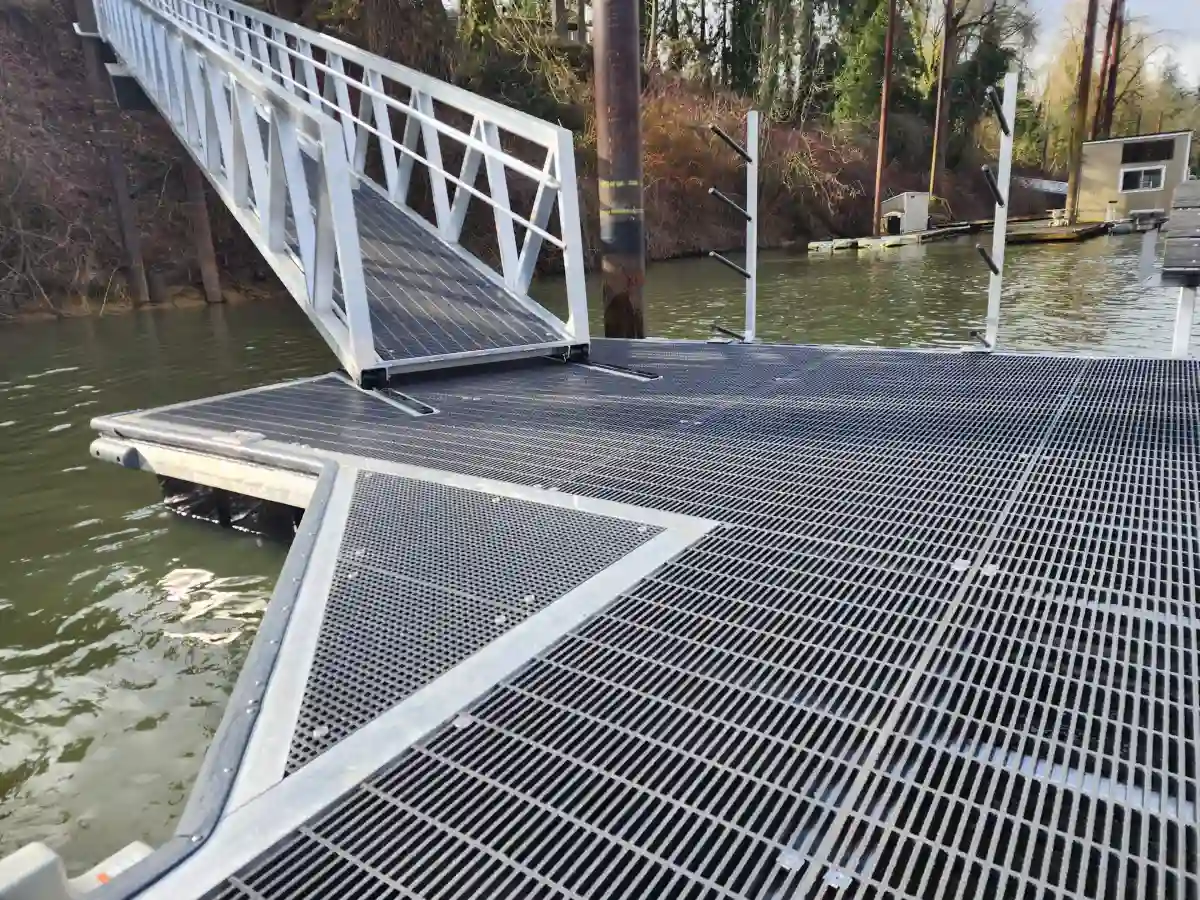
| Marine & Dockside | UV-stabilized resin (no yellowing in <5 years); salt-water immersion rated; no galvanic corrosion with aluminum structures | UV aging test data, ASTM E84 | No UV stabilization data; standard polyester (will degrade in direct sunlight) |
Key takeaway: A manufacturer who says "our grating works for everything" without asking about your specific chemical exposure, loading conditions, and environmental factors is not the partner you want. The right manufacturer asks detailed questions about your application before quoting — because they understand that the wrong resin choice can mean product failure in months, not years.
Why FRP Grating Pro: Our Manufacturing Credentials
ISO 9001:2015 Certified
Quality management certified by accredited registrar. Certificate available. Audited annually.
85,000 Sq Ft Facility
Houston, Texas. Verifiable industrial address. Open for audits. Virtual tours within 48 hours.
500+ Projects | 50+ Countries
References available by industry: chemical, wastewater, offshore, food, power, marine.
Full ASTM / ANSI / EN Compliance
ASTM E84 Class 1, D635, ANSI MBG 531, EN 13706. Load test reports by batch.
No MOQ on Stock Panels
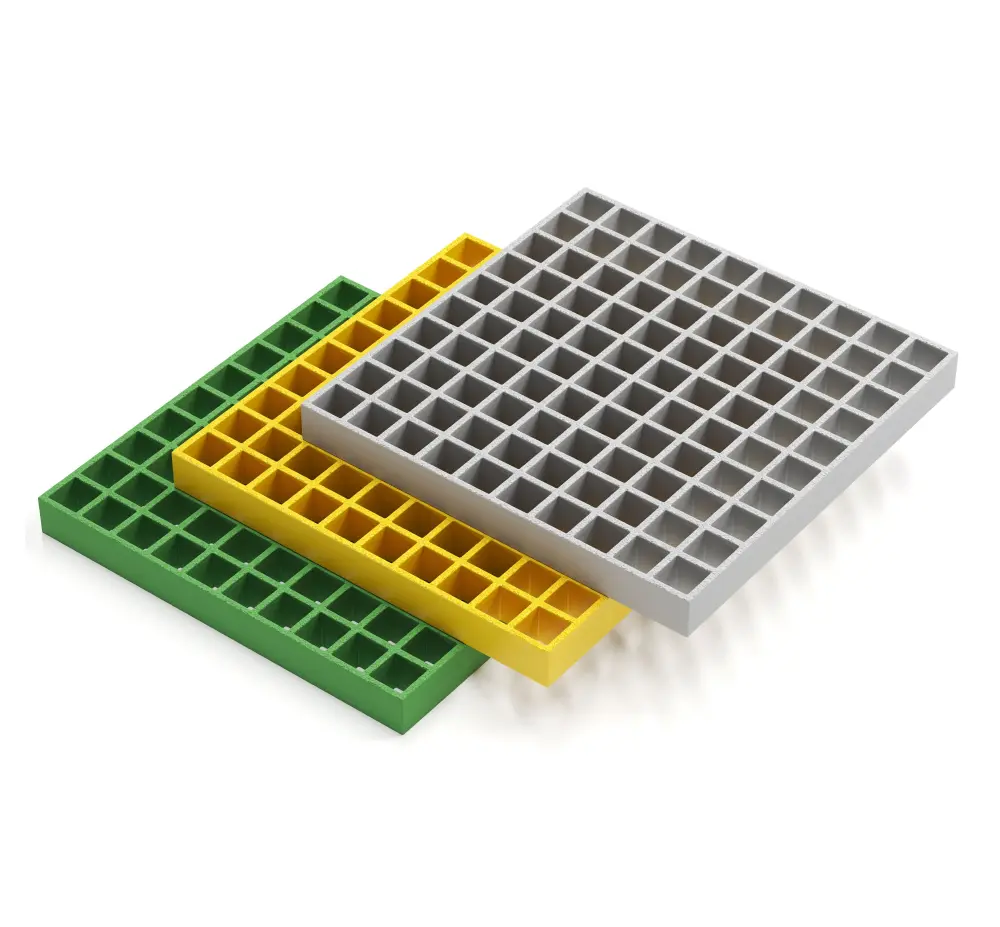
4×8 ft and 4×12 ft in gray, green, yellow. Single panel shipping. Volume discounts at 100+.
Frequently Asked Questions
Three checks: (1) Ask for ISO 9001:2015 certificate and verify the number. (2) Google Maps their address — manufacturer = industrial facility. (3) Ask glass content % for molded vs pultruded. A manufacturer answers instantly. FRP Grating Pro: 85,000 sq ft Houston facility with full ISO certification and virtual tours.
Panel type, dimensions, depth, mesh size, resin type, ASTM/ANSI/EN standards, load test requirements, surface type, color, quantity tolerance (±5%), delivery terms (FOB/CIF), inspection criteria, warranty terms, and payment schedule. A well-written PO eliminates 90% of post-delivery disputes.
Under 500 panels: US wins on lead time (1–2 weeks vs 8–12), quality recourse, and support. 1,000+ panels: overseas can save if you audit the factory. FRP Grating Pro manufactures in Houston — domestic speed, global pricing.
Standard panels: 1–2 weeks. Custom sizes, standard resin: 3–4 weeks. Custom resin or color: 4–6 weeks. Large orders (500+): add 1–2 weeks. Less than 1 week for custom = corners cut on cure time.
30–50% deposit with PO, balance before shipment or net-30 for established accounts. L/C for international. Avoid 100% upfront. Tie final payment to documented inspection.
Yes — and you should. Legitimate manufacturers provide sample panels free or at nominal cost. Examine surface finish, color, thickness, and edge quality. Request batch test report. Refusal = red flag. FRP Grating Pro provides samples on request.
Ready to Audit Your Next FRP Grating Supplier?
Request a sample panel, schedule a virtual factory tour, or get a detailed quote with load test data for your specific project. ISO 9001:2015 certified. 85,000 sq ft Houston facility. 24-hour quote response.