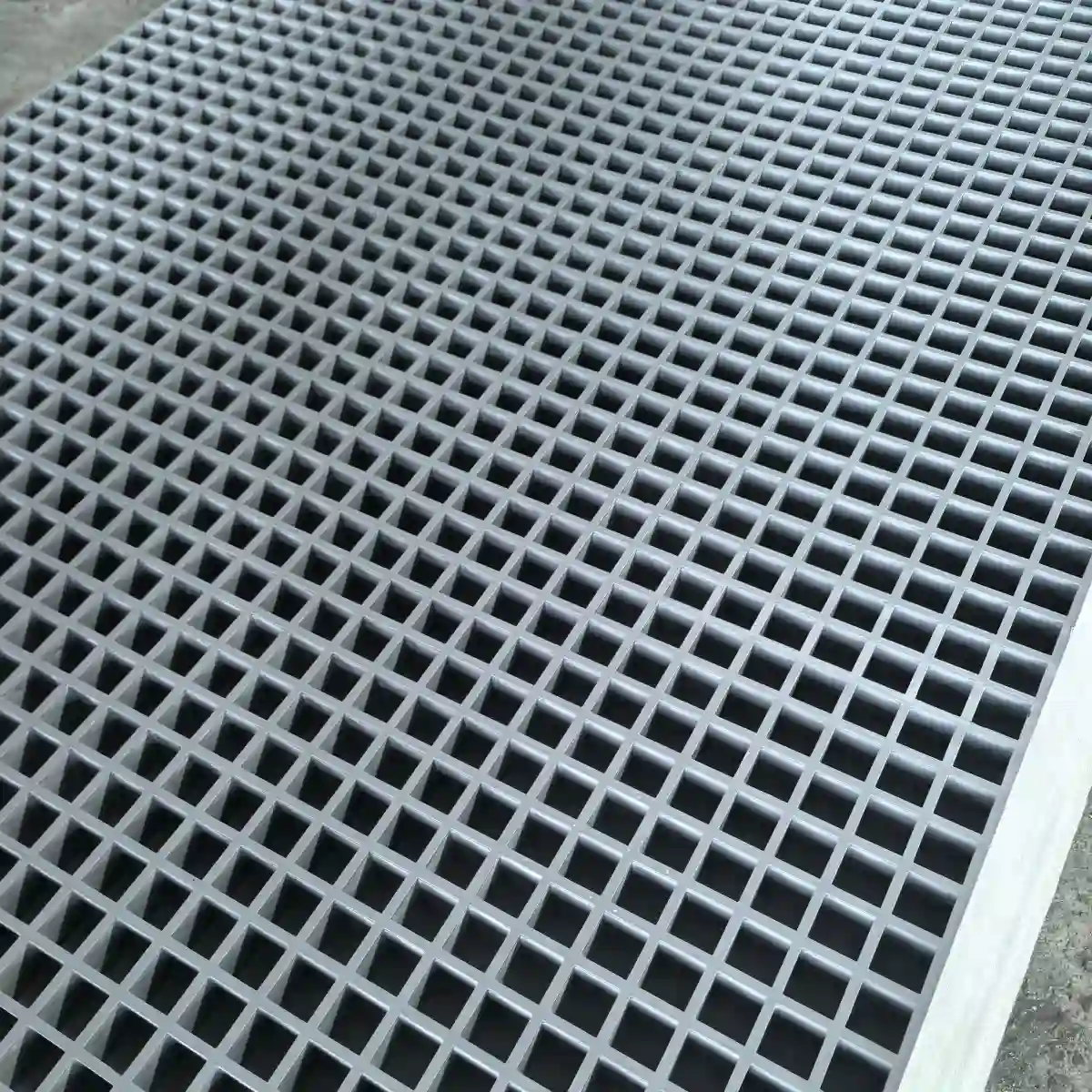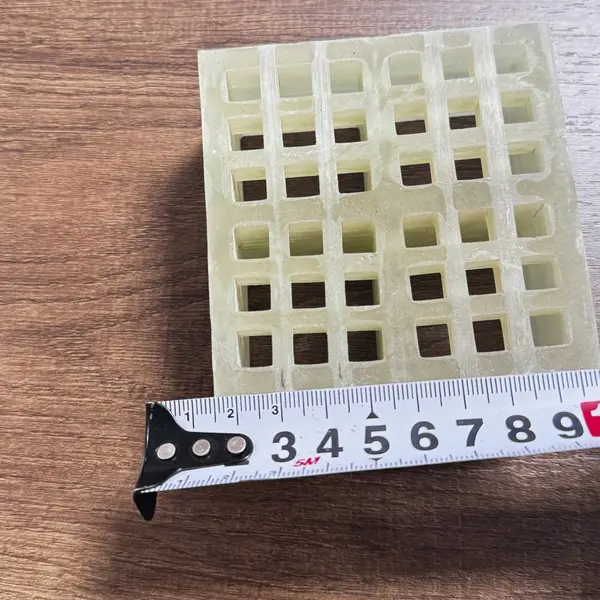
Whether you are a structural engineer evaluating load ratings for an offshore platform, a procurement manager sourcing FRP grating for chemical plant flooring, or a contractor planning an industrial walkway installation — choosing the right FRP grating directly affects project safety, timeline, and total cost of ownership.
This guide consolidates everything you need in one place: molded vs pultruded comparison, load capacity specifications, resin selection, pricing factors, and a step-by-step selection workflow. Every data point comes from our ISO 9001:2015 certified factory in Houston, Texas — backed by 15+ years of manufacturing and export to over 50 countries across six continents.
What Is FRP Grating?
FRP grating is manufactured through an open-mold process where continuous fiberglass rovings are saturated with liquid resin and cured under controlled conditions. The resulting product combines the tensile strength of glass fibers with the chemical resistance of the resin system — yielding a structural flooring material that outperforms traditional steel and aluminum grating in corrosive, wet, or electrically sensitive environments.
How it differs from metal grating: Unlike steel grating — which requires hot-dip galvanizing and still corrodes over time — FRP grating is inherently corrosion-proof. It is also non-conductive, non-magnetic, and roughly 70% lighter than equivalent steel grating, which reduces structural dead load and simplifies installation labor. These properties make it the preferred material for chemical plants, wastewater treatment facilities, offshore platforms, food processing plants, and any environment where corrosion or electrical safety is a concern.
The manufacturing process at our 85,000 sq ft Houston facility follows strict quality control under ISO 9001:2015 standards. Each panel undergoes visual inspection, dimensional verification, and load testing before shipment to over 50 countries across North America, South America, Europe, Middle East & Africa, Asia Pacific, and Central America.
Types of FRP Grating: Molded vs Pultruded
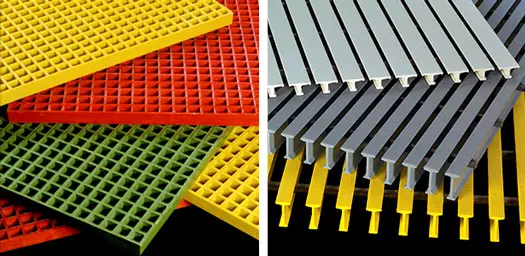
The first and most critical decision in any FRP grating project is choosing between molded and pultruded construction. They differ fundamentally in manufacturing method, structural behavior, and optimal use cases. Here is how they compare across every meaningful dimension:
| Feature | Molded FRP Grating | Pultruded FRP Grating |
|---|---|---|
| Manufacturing | Open-mold casting: glass rovings layered in mold, saturated with resin, cured as a single piece | Continuous pultrusion: glass fibers pulled through resin bath and heated die, then assembled into grating panels |
| Strength Direction | Bi-directional — equal strength in both X and Y axes | Uni-directional — strongest along the bearing bar direction |
| Glass Content | ~30–40% by weight; ~65% resin by volume | 65–75% by weight |
| Standard Panel | 48 × 96 in (1220 × 2440 mm); also 36×120, 48×144, 60×120 in | 48 × 144 in (1220 × 3660 mm) |
| Available Depths | 1 in, 1.25 in, 1.5 in, 2 in (25 / 32 / 38 / 50 mm) | 1 in, 1.5 in, 2 in (25 / 38 / 50 mm) |
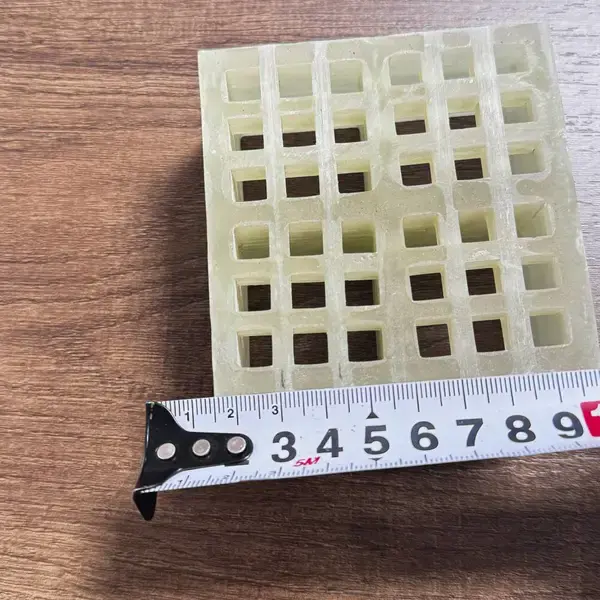
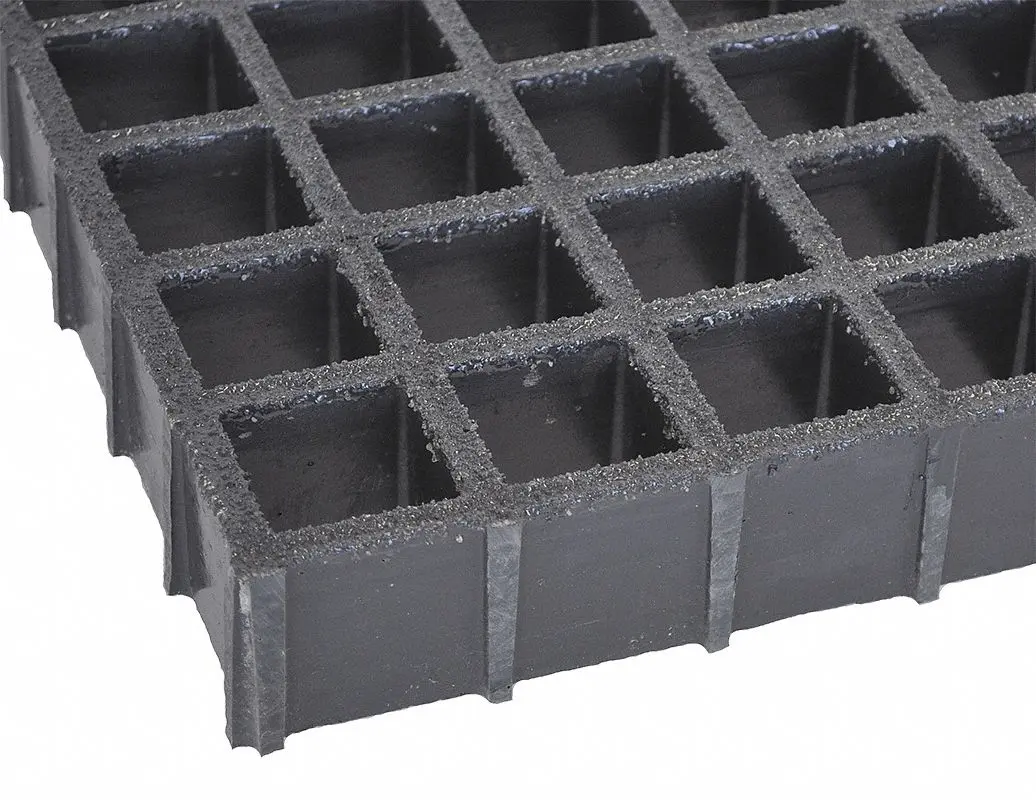
| Mesh Configuration | Square mesh: 1.5×1.5 in (38×38 mm) standard; 1×1 in, 2×2 in available | Rectangular open area between bearing bars; I-bar and T-bar profiles available |
| Corrosion Resistance |
Superior — high resin content fully encapsulates fibers
|
Excellent — cut edges require sealing
|
| Span Capability |
Up to 4 ft typical
|
Up to 6+ ft with T-bar
|
| Best Applications | Chemical plants, plating lines, trench covers, sump areas, platforms requiring cutouts | Long-span walkways, bridges, elevated platforms, areas with high concentrated loads |
Which one should you choose? If your project involves corrosive chemical exposure, frequent cutouts for pipes or equipment, or multi-directional traffic — choose molded FRP grating. See our molded FRP grating product specifications for detailed panel data. If you need long clear spans (>4 ft between supports), high concentrated loads, or bidirectional strength is less critical — pultruded FRP grating is your answer. Review the pultruded FRP grating load tables for span-by-span capacity data.
FRP Grating vs Steel Grating: Key Benefits Comparison
For decades, steel grating was the default choice for industrial flooring. But in environments where corrosion, weight, or electrical safety matter, FRP grating delivers measurable advantages. Here is how the two materials compare on the metrics that affect your project's total cost of ownership:
FRP Grating Advantages
- Corrosion-proof: Never rusts. No galvanizing required. Survives decades in chemical, marine, and wastewater environments where steel fails in 3–5 years.
- 70% lighter: A standard 4×8 ft FRP panel weighs ~45–55 lbs vs ~150 lbs for equivalent steel grating. Reduces structural steel requirements and installation labor by 50%+.
- Non-conductive: Zero electrical hazard. Safe for electrical rooms, substations, and areas with high-voltage equipment.
- Non-magnetic: Suitable for MRI facilities, military applications, and sensitive electronic environments.
- Fire retardant: ASTM E84 Class 1, Flame Spread 25 or less. Self-extinguishing formulations available.
- Lower lifecycle cost: Zero maintenance — no repainting, no rust removal. 25+ year service life in most environments.
When Steel Still Makes Sense
- Extreme temperatures: Standard FRP rated to ~200°F (93°C) continuous. Above 300°F → steel required (or specify phenolic resin FRP for up to 350°F).
- Impact-only loads: In heavy foundry or steel mill environments where molten metal splash is present, steel grating is mandatory.
- Budget-first projects: Lowest upfront cost for dry, non-corrosive indoor environments with no electrical concerns.
FRP Grating Specifications & Load Capacity
Load capacity is the specification that matters most to structural engineers. FRP grating load ratings depend on four interdependent variables: panel depth, span between supports, glass content, and resin type. The table below provides design reference values based on our ISO 9001:2015 certified manufacturing data:
| Panel Type | Depth | Span (Clear) | Uniform Load (psf) | Concentrated Load (lbs / 12"×12") | Deflection |
|---|---|---|---|---|---|
| Molded (Polyester) | 1 in (25 mm) | 24 in (610 mm) | 300 | 1,200 | ≤ L/100 |
| Molded (Polyester) | 1.5 in (38 mm) | 36 in (914 mm) | 400 | 1,800 | ≤ L/100 |
| Molded (Polyester) | 2 in (50 mm) | 48 in (1220 mm) | 500 | 2,500 | ≤ L/100 |
| Pultruded (T-5018) | 1.5 in (38 mm) | 48 in (1220 mm) | 350 | 1,500 | ≤ L/180 |
| Pultruded (T-5020) | 2 in (50 mm) | 60 in (1524 mm) | 450 | 2,200 | ≤ L/180 |
| Pultruded (T-5025) | 2 in (50 mm) | 72 in (1829 mm) | 500 | 3,000 | ≤ L/180 |
0.24" on 24" span
0.27" on 48" span
All load ratings
FRP Grating Applications Across Industries
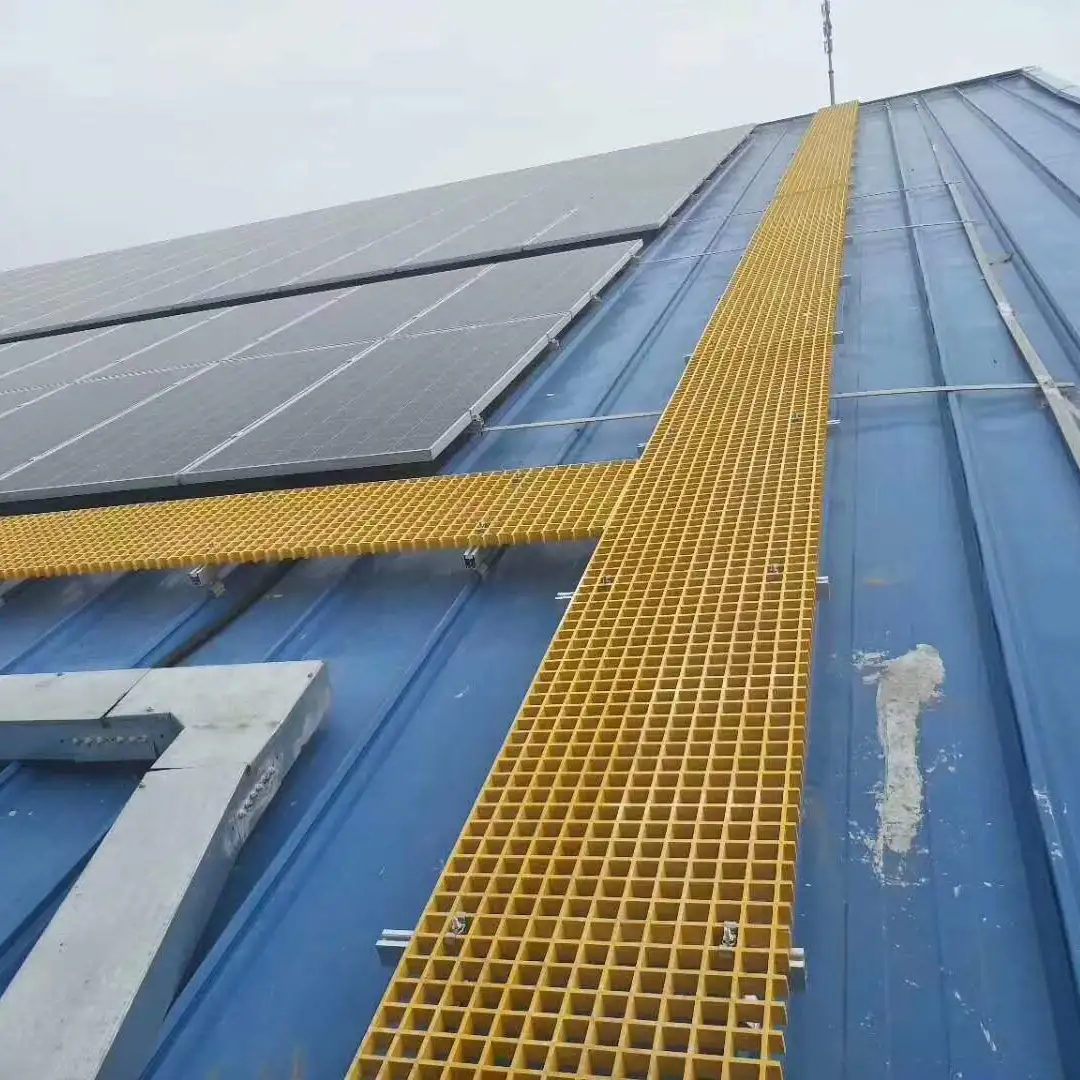
FRP grating has become the standard flooring solution across industries where corrosion resistance, safety, and low maintenance are non-negotiable. Here are the applications where FRP grating consistently outperforms metal alternatives:
Chemical Processing Plants
Flooring, trench covers, and platform decks in chlor-alkali, acid production, electroplating, and petrochemical facilities. Vinyl ester resin withstands continuous exposure to 37% HCl, 50% NaOH — environments where steel grating fails within 12–18 months.
Wastewater Treatment
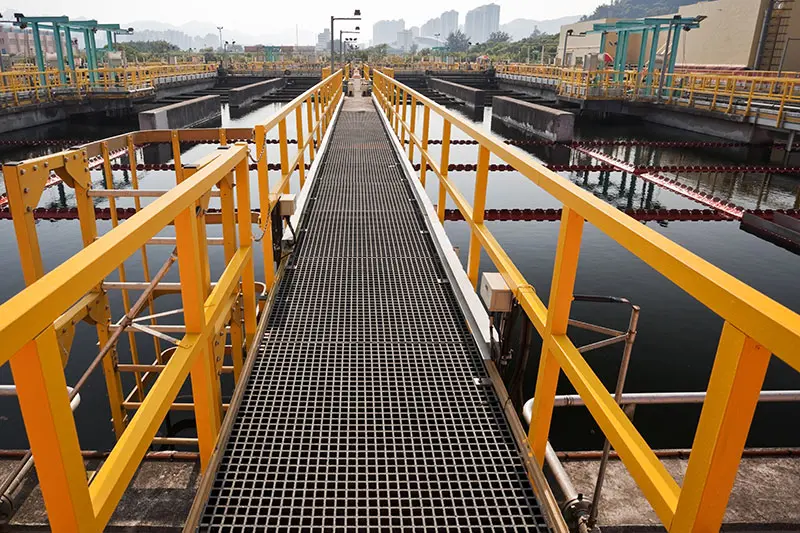
Walkways over aeration basins, clarifier bridges, screen platforms. Anti-slip surface remains effective when wet. Municipal and industrial plants standardize on FRP for 20+ year zero-maintenance service.
Oil & Gas Platforms
Deck grating, helideck walkways, pipe rack access. 70% lighter than steel reduces topside structural load. Corrosion-proof in salt spray and H₂S environments. Non-sparking for hazardous zones.
Food & Beverage Processing
Flooring in washdown areas, bottling lines, cold storage. USDA-accepted for food contact zones. Withstands repeated high-pressure steam cleaning without degradation. See walkway solutions.
Power Generation
Non-conductive grating for transformer bays, switchgear rooms, battery storage areas, and cable trench covers. Eliminates electrical hazard risk entirely — no grounding required.
Marine & Dockside
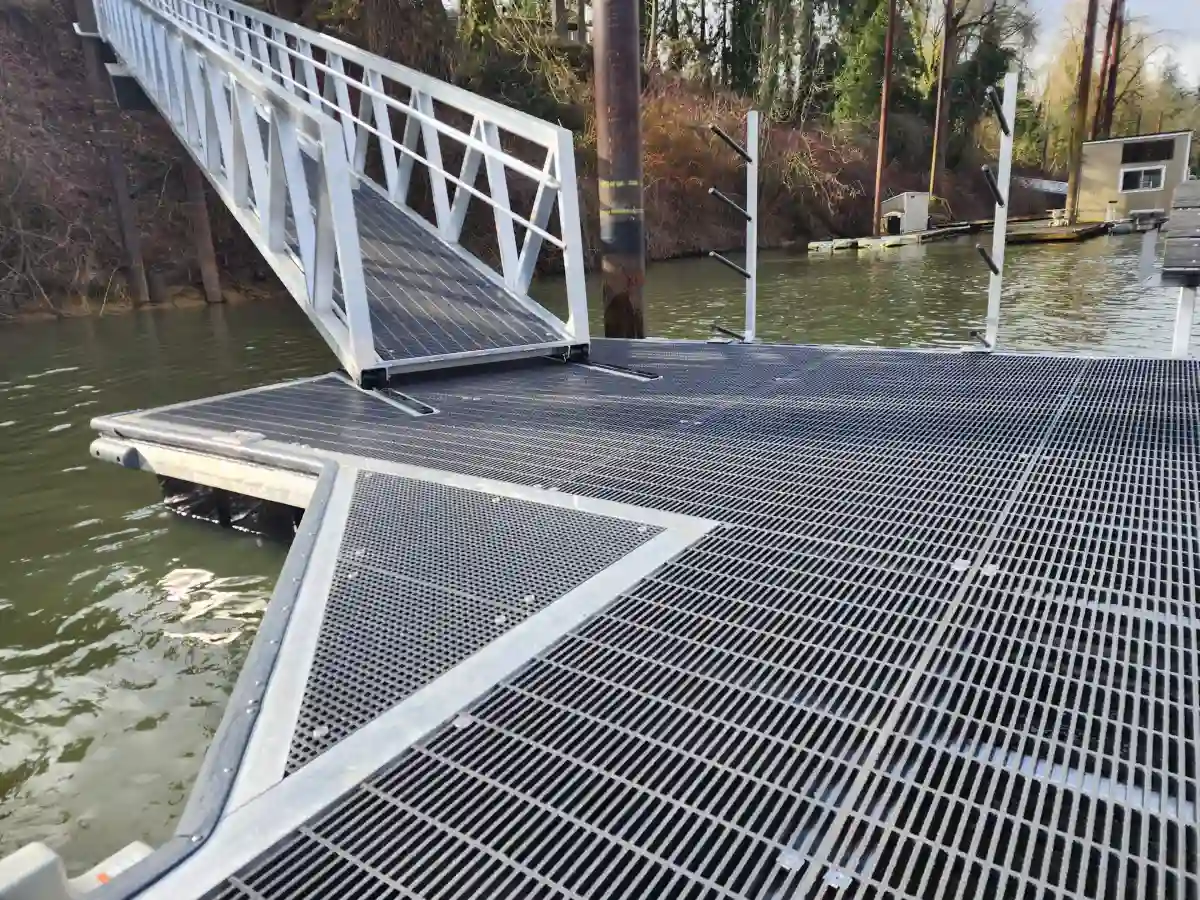
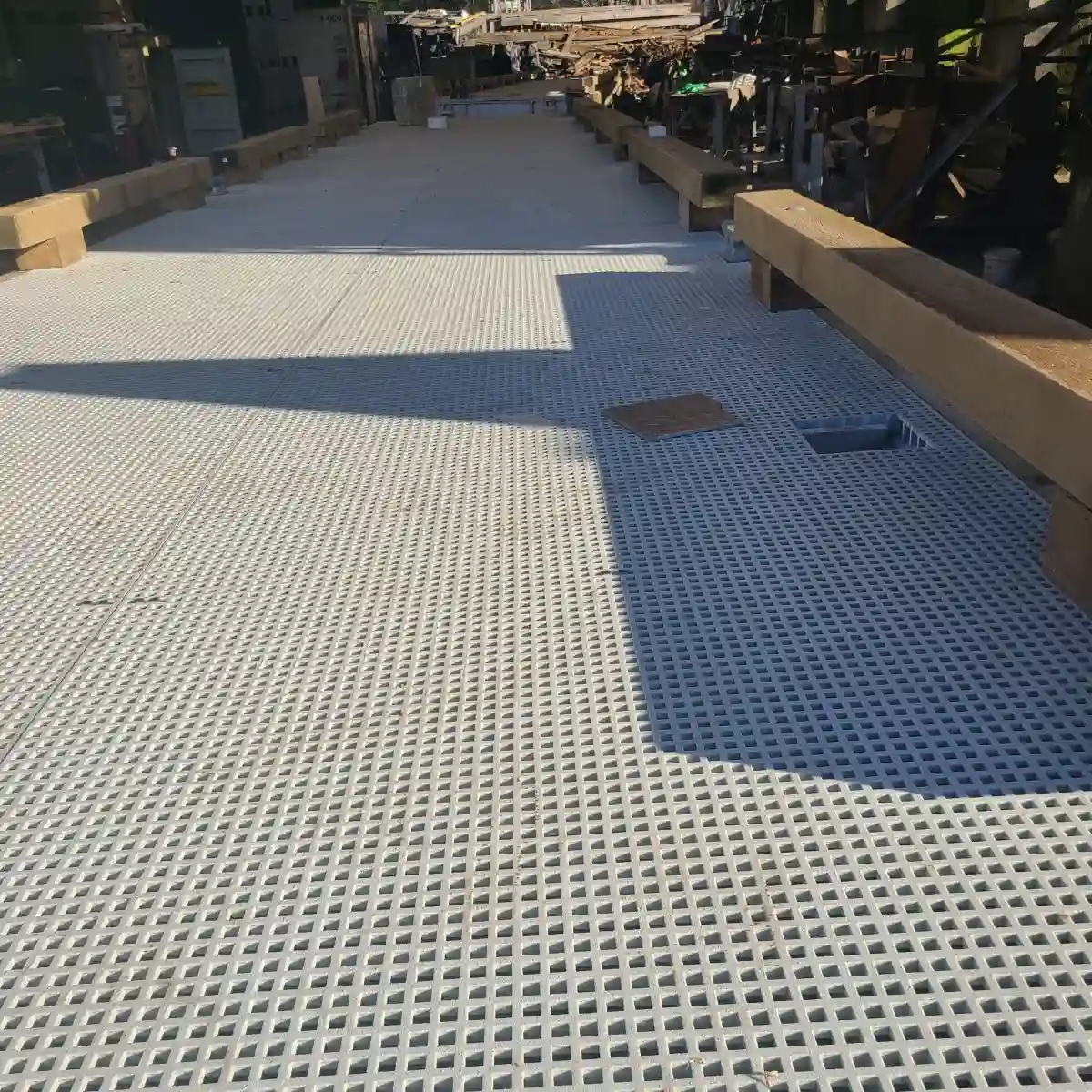
Pier decking, marina walkways, floating dock surfaces, boat ramp grating. UV-stabilized, salt-water-proof, slip-resistant even when wet. No electrolysis or galvanic corrosion.
FRP Grating Pricing: What Affects Your Cost
FRP grating pricing is not a single per-square-foot number. It varies significantly based on five key factors. Understanding these helps you budget accurately and avoid surprise costs:
Panel Depth (Thickness)
1-inch panels are the cost baseline. Each 0.5-inch increase in depth adds approximately 20–25% to material cost, but also increases span capability — potentially reducing the number of support beams needed and lowering overall project cost.
Resin Type
Standard isophthalic polyester is the most economical. Vinyl ester resin (required for strong acid/alkali environments) adds 30–40% to material cost. Phenolic resin (for fire-rated and high-temperature applications up to 350°F) is the premium option.
Surface Type
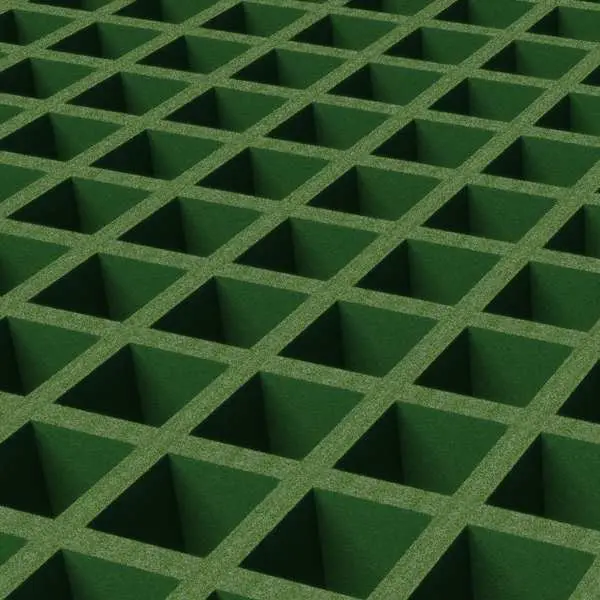
Standard concave (meniscus) surface — the natural mold finish — is included at no extra cost. Grit-top surface for enhanced slip resistance adds a secondary manufacturing step. Aluminum oxide grit (heavy industrial) is the most expensive surface option but provides the highest coefficient of friction.
Order Volume & Customization
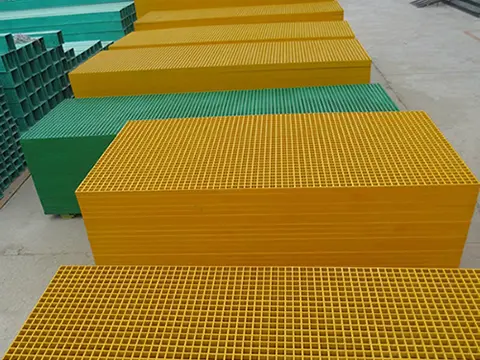
Standard panel sizes (4×8 ft, 4×12 ft) in stock colors (gray, green, yellow) carry the lowest unit cost. Custom panel sizes, non-standard RAL colors, and small-batch orders increase per-unit cost. Our 85,000 sq ft facility enables competitive pricing on bulk orders — contact us for volume discount tiers.
Shipping & Logistics
FRP grating's light weight (70% lighter than steel) significantly reduces freight costs compared to metal grating. We ship from Houston, Texas to all 50 US states and export to 50+ countries. Bulk orders benefit from container-optimized loading to minimize per-unit shipping cost.
How to Choose the Right FRP Grating: 4-Step Selection Guide
Use this systematic workflow to determine the optimal FRP grating configuration for your project. Each step narrows the options until you arrive at a spec-ready selection.
-
Step 1: Identify Your Environment
What chemicals, temperatures, and exposure conditions will the grating face? For continuous acid immersion → vinyl ester resin. For general industrial with occasional chemical splash → standard polyester. For high-temperature (>200°F) → phenolic resin. For food processing washdown → FDA-compliant polyester. Document your chemical concentration, temperature range, and UV exposure — these determine resin selection.
-
Step 2: Calculate Your Load Requirements
Determine the maximum uniform load (psf) and concentrated load (lbs) your grating must support. Include live loads (pedestrians, forklifts, equipment) and any potential impact loads. Then measure the clear span between supports. Use our load capacity table above to find the minimum panel depth that satisfies both your load and span requirements with a 3:1 safety factor.
-
Step 3: Choose Molded or Pultruded
If your project requires multi-directional strength, frequent cutouts (>10" diameter openings for piping), or maximum corrosion resistance → molded FRP grating. If you need long spans (>4 ft), high uni-directional strength, or the lowest weight per square foot → pultruded FRP grating. Review the comparison table in Section 2 for the full decision matrix.
-
Step 4: Specify Surface & Color
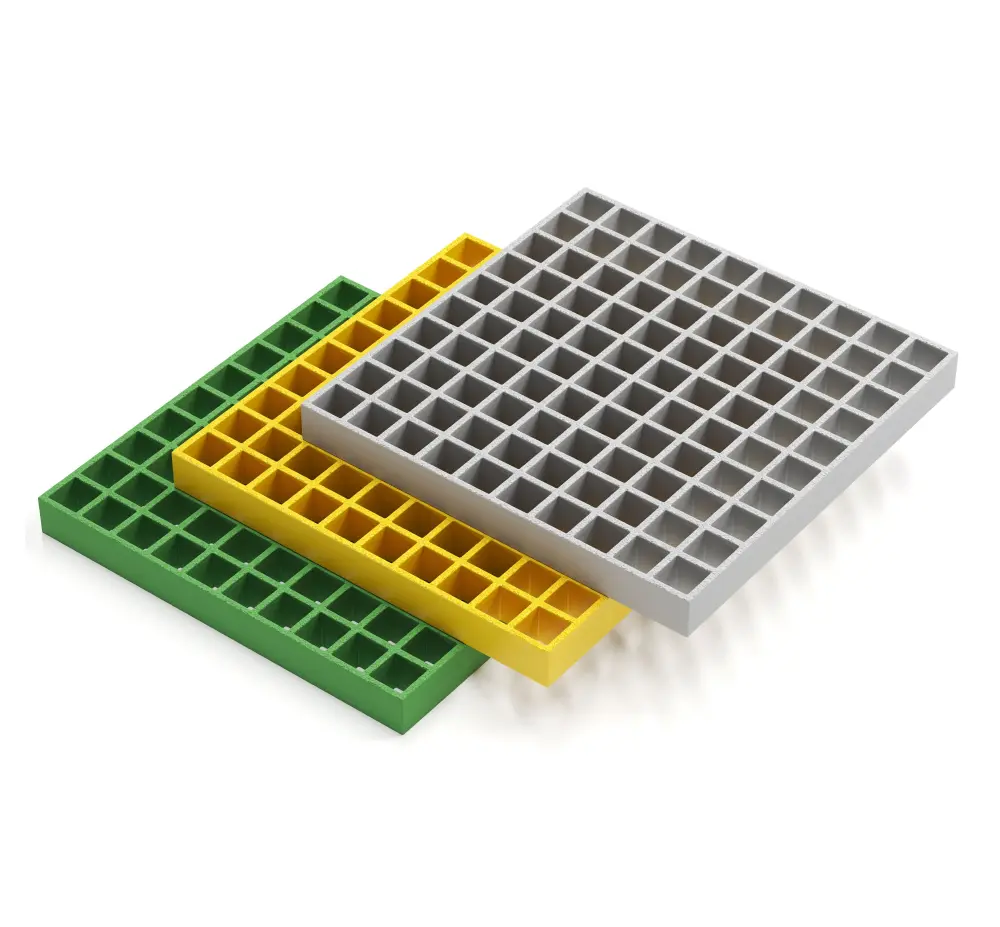
Standard concave surface provides good slip resistance at no extra cost. Grit-top surface (standard or aluminum oxide) is recommended for wet, oily, or ice-prone environments. Select from stock colors (Light Gray, Green, Yellow) for fastest delivery, or specify any RAL color for custom architectural projects. Conductive black grit surface is available for electrostatic discharge (ESD) sensitive environments.
Frequently Asked Questions
FRP stands for Fiberglass Reinforced Plastic. It is a composite material made from continuous glass fiber rovings embedded in a thermosetting resin (typically polyester, vinyl ester, or phenolic). The term GRP (Glass Reinforced Plastic) is used interchangeably, particularly in the UK, Europe, and Commonwealth countries. There is no technical difference between FRP and GRP grating — both refer to the same fiberglass composite material.
FRP grating is not stronger than steel in absolute tensile or yield strength — steel has a higher modulus of elasticity. However, FRP grating has a significantly higher strength-to-weight ratio. A molded FRP panel weighing 50 lbs can support the same uniform load as a 150 lb steel grating panel. For most industrial walkway and platform applications (300–500 psf uniform load), FRP grating matches or exceeds steel performance while being 70% lighter, corrosion-proof, and non-conductive. The key tradeoff: FRP has lower stiffness (higher deflection under load), which is why deflection limits (L/100 or L/180) — not ultimate strength — typically govern FRP grating design.
Molded FRP grating is made by layering continuous glass rovings in an open mold, saturating them with resin, and curing as a single piece. This creates bi-directional strength and superior corrosion resistance due to high resin content (~65% by volume). Pultruded FRP grating is made by pulling glass fibers through a resin bath and heated die to form bearing bars, which are then assembled into grating panels. This yields uni-directional strength, higher glass content (65–75% by weight), and longer span capability. Choose molded for chemical environments; choose pultruded for long spans and high concentrated loads.
In typical industrial environments, FRP grating has a service life of 20–25+ years with zero maintenance. Unlike steel grating — which requires periodic repainting, rust removal, and eventual replacement after 5–10 years in corrosive environments — FRP grating's corrosion resistance is inherent to the material itself. The resin matrix completely encapsulates the glass fibers, preventing moisture ingress, chemical attack, and UV degradation. UV-stabilized formulations prevent surface yellowing and maintain mechanical properties for outdoor applications.
Yes. FRP grating can be cut on site using standard carbide-tipped or diamond-grit blades — no special equipment required. A circular saw, jigsaw, or angle grinder with a masonry or diamond blade works well. Unlike steel grating, there are no sparks during cutting (safe for hazardous environments) and no hot-work permits are typically required. When cutting pultruded grating, the exposed cut edges should be sealed with resin to protect the glass fibers. Molded grating does not require edge sealing due to its higher resin content. Always wear appropriate PPE (respirator, eye protection) when cutting FRP materials.
Key standards: ASTM E84 (Surface Burning, Class 1, Flame Spread ≤25), ASTM D635 (Rate of Burning), ANSI/NAAMM MBG 531 (Molded FRP Grating), EN 13706 (Pultruded Profiles). Our facility is ISO 9001:2015 certified. For application-specific compliance: OSHA walking-working surfaces for walkways, ADA mesh ≤½ inch for accessible routes, USDA acceptance for food contact. All FRP Grating Pro products meet these standards.
For standard stock panels (4×8 ft and 4×12 ft in Light Gray, Green, or Yellow), there is no minimum order quantity — single panels ship from our Houston warehouse. For custom sizes, colors, or resin formulations, the MOQ varies by specification but typically starts at 10–20 panels. Large projects (500+ panels) receive volume discount pricing. We export to 50+ countries across six continents.
Request Your Factory-Direct FRP Grating Quote
Tell us your project requirements — panel type, dimensions, resin, surface, and quantity — and receive a detailed quote within 24 hours. No distributor markup. ISO 9001:2015 certified. 15+ years serving 50+ countries.