Introduction
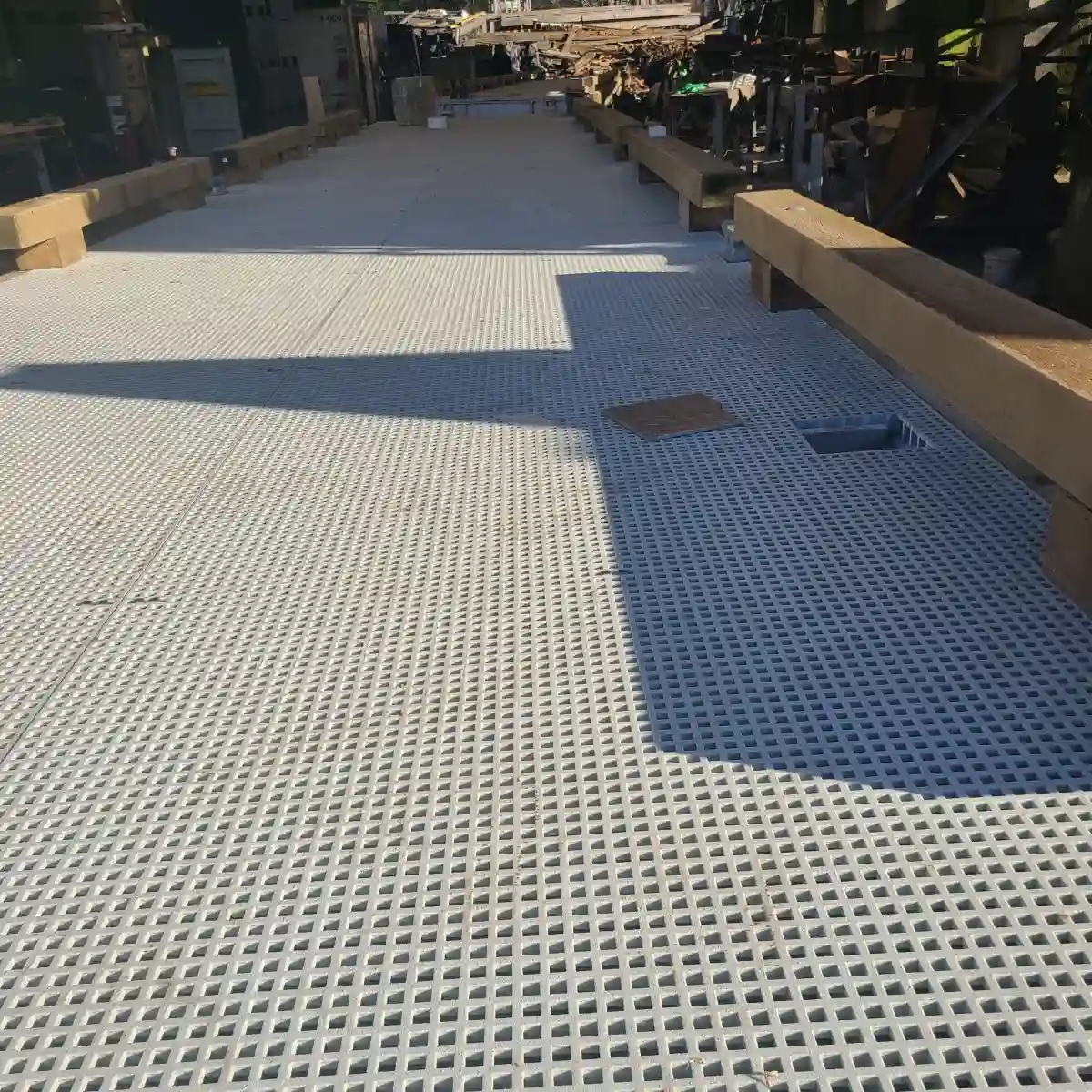
When planning an industrial flooring project, understanding standard FRP grating dimensions is essential for ensuring proper fit, load performance, and cost efficiency. Fiberglass reinforced plastic (FRP) grating is available in a range of standard panel sizes, thicknesses, and bearing bar configurations that accommodate most walkway, platform, and trench cover applications. This complete reference guide covers everything you need to know about FRP grating sizes — from typical panel dimensions and thickness options to span ratings and measurement methods. Whether you are selecting material for a new installation or replacing existing grating, knowing the standard sizing conventions will help you make informed decisions and avoid costly custom fabrication.
What Are Standard FRP Grating Dimensions?
Standard FRP grating dimensions refer to the commonly manufactured panel sizes, thicknesses, and bearing bar spacings that are readily available without custom tooling. These sizing conventions follow industry standards established by manufacturers such as McNichols, Bedford, Strongwell, and Fibergrate, and are widely accepted across industrial, commercial, and infrastructure projects.
Standard Panel Sizes
The most common standard panel size for FRP grating is 4 ft × 8 ft (1,219 mm × 2,438 mm) for molded grating and 3 ft × 20 ft (914 mm × 6,096 mm) for pultruded grating. However, variations exist depending on the manufacturer and grating type:
- Molded FRP grating: Typically available in 4 ft × 8 ft and 4 ft × 12 ft panels. Some manufacturers also offer 3 ft × 5 ft and 3 ft × 10 ft sizes for lighter-duty applications.
- Pultruded FRP grating: Commonly produced in 3 ft × 20 ft and 3 ft × 24 ft panels, with 2 ft × 20 ft and 4 ft × 20 ft also available. The longer lengths make pultruded grating ideal for continuous walkways and long-span installations.
Standard Span Widths and Lengths
When evaluating FRP grating sizes, it is important to distinguish between panel dimensions and clear span. The clear span — the distance between support centers — determines the load capacity. Common span widths for standard FRP grating products include 12 in, 18 in, 24 in, and 30 in, while standard bearing bar lengths range from 3 ft to 20 ft depending on the grating profile.
Bearing Bar Spacing and Mesh Configuration
Standard FRP grating configurations also include the center-to-center spacing of bearing bars and cross bars:
- Molded grating: 1.5 in × 1.5 in square mesh pattern is most common, with 1 in × 1 in and 2 in × 2 in also available
- Pultruded grating: Bearing bar spacing of 1.5 in on center is standard, with 1.0 in and 2.0 in spacing offered for higher load or lighter weight requirements
These standard dimensions ensure compatibility with most structural steel supports and allow for straightforward field cutting and modification on site.
Standard FRP Grating Thickness Options
FRP grating is manufactured in several standard thicknesses, each designed to support different load ranges. The thickness directly affects the load capacity, deflection, and overall stiffness of the panel. Choosing the correct thickness is critical to meeting safety requirements and performance expectations.
| Thickness | Typical Use Case | Approximate Load Capacity |
|---|---|---|
| 1 in (25 mm) | Light pedestrian walkways, mezzanine floors, decorative applications | Up to 125 psf |
| 1.5 in (38 mm) | General industrial walkways, platforms, and trench covers | Up to 300 psf |
| 2 in (50 mm) | Heavy industrial platforms, vehicle access, equipment supports | Up to 600 psf |
| 2.5 in (63 mm) | Extra-heavy duty applications, forklift traffic, industrial catwalks | Up to 800 psf |
| 3 in (75 mm) | Extreme heavy loading, industrial bridge decking, crane rails | 1,000 psf+ |
Thickness by Grating Type
Molded FRP grating is typically available in 1 in, 1.5 in, and 2 in thicknesses. The 1.5 in molded grating is the most widely specified option for general industrial use. Pultruded FRP grating offers a wider range from 1 in to 3 in, with 1.5 in and 2 in being the most common. The pultrusion process allows for consistent dimensional accuracy across longer panel lengths.
Relationship Between Thickness and Deflection
As a rule of thumb, doubling the thickness of an FRP grating panel increases its stiffness by approximately eight times. This means that selecting a 2 in thick grating instead of 1.5 in can dramatically reduce deflection under load. However, thicker panels also weigh more and cost more. When evaluating FRP grating sizes and thickness, always check the manufacturer load-deflection tables to confirm that the chosen thickness meets your project deflection limits — typically L/100 or L/150 for industrial walkways.
Common FRP Grating Panel Sizes and Configurations
Beyond standard panel sizes, FRP grating is available in several configurations that affect overall dimensions and performance characteristics. Understanding the differences between molded and pultruded grating sizes is essential for proper material selection.
Molded FRP Grating Standard Sizes
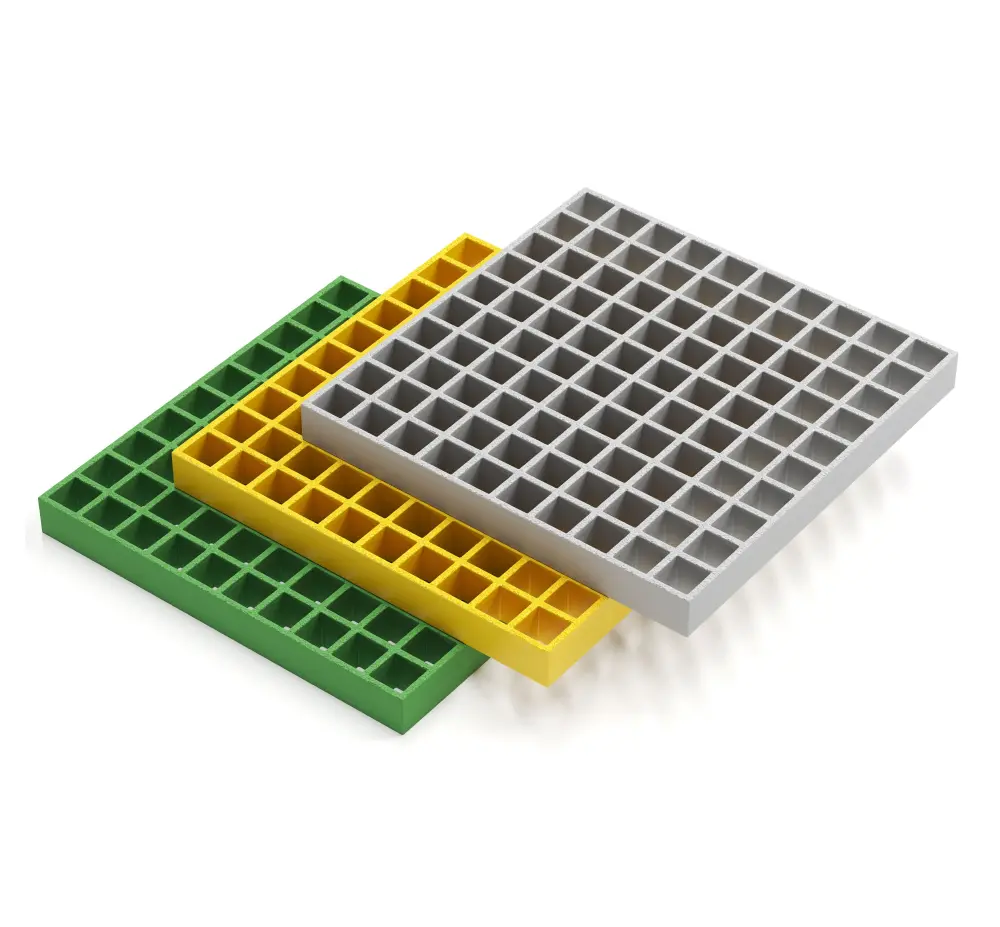
Molded FRP grating is produced by embedding fiberglass reinforcement in a resin matrix within a heated mold. This process creates a one-piece grating with an integrated mesh pattern. Standard FRP grating sizes for molded panels include:
- Panel sizes: 4 ft × 8 ft (1,219 mm × 2,438 mm) is the industry standard. Some manufacturers also offer 4 ft × 12 ft (1,219 mm × 3,658 mm) and 3 ft × 5 ft (914 mm × 1,524 mm) panels.
- Thickness options: 1 in (25 mm), 1.5 in (38 mm), and 2 in (50 mm)
- Mesh patterns: 1.5 in × 1.5 in square grid is standard. Mini-mesh (0.5 in × 0.5 in or 1 in × 1 in) is available for applications requiring smaller openings, such as tool drop protection or high-heel traffic areas.
- Surface options: Standard grit-top surface for slip resistance or concave surface for drainage
Pultruded FRP Grating Standard Sizes
Pultruded FRP grating is manufactured by pulling continuous fiberglass rovings and mat through a resin bath and heated die. This produces a grating with high strength-to-weight ratio and longer continuous lengths. Common FRP grating sizes for pultruded products include:
- Panel sizes: 3 ft × 20 ft (914 mm × 6,096 mm) is most common. Also available in 3 ft × 24 ft (914 mm × 7,315 mm), 2 ft × 20 ft (610 mm × 6,096 mm), and 4 ft × 20 ft (1,219 mm × 6,096 mm).
- Thickness options: 1 in (25 mm), 1.5 in (38 mm), 2 in (50 mm), 2.5 in (63 mm), and 3 in (75 mm)
- Bearing bar spacing: 1.5 in on center is standard; 1.0 in and 2.0 in spacings are available for specialized requirements
- Cross bar spacing: Typically 2 in or 4 in on center
The longer panel lengths of pultruded grating make it the preferred choice for applications requiring fewer joints and faster installation. When comparing molded and pultruded types, consider that pultruded grating typically offers higher load capacity per inch of thickness due to its unidirectional fiber orientation.
How to Measure FRP Grating Dimensions Correctly
Accurate measurement of FRP grating dimensions is critical for ensuring proper fit on support structures and avoiding costly field modifications. Follow these guidelines when measuring grating for your project.
Key Dimensions to Measure
- Panel length: Measure along the bearing bar direction (the long dimension of the panel). For molded grating, this is typically 8 ft; for pultruded grating, up to 20 ft or more.
- Panel width: Measure across the width perpendicular to the bearing bars. Standard widths are 3 ft or 4 ft.
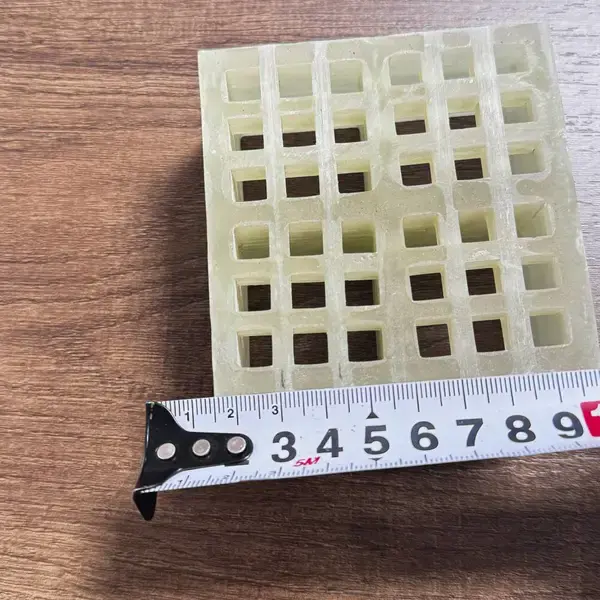
- Thickness: Measure the overall height of the grating from the top surface to the bottom. Use calipers for precise measurement.
- Bearing bar spacing: Measure center-to-center distance between adjacent bearing bars to confirm the grid configuration.
Measurement Tips for Accuracy
- Measure at multiple points: FRP grating can have slight manufacturing tolerances. Measure both ends and the middle of each panel to identify any variation.
- Account for thermal expansion: FRP grating expands and contracts with temperature changes. Allow 1/8 in to 1/4 in gap per 10 ft of panel length when fitting between supports.
- Check support flange width: The bearing bar dimension must overlap the support flange by at least 3/4 in (19 mm) on each end for adequate load transfer.
- Verify cut dimensions twice: If cutting standard panels to custom widths, measure the support opening and subtract 1/4 in for installation clearance.
Common Measurement Mistakes
One frequent error when working with FRP grating sizes is confusing the overall panel dimension with the clear span. The clear span is the unsupported distance between support centers, not the total panel length. Always verify that your support spacing matches the grating load rating, not just the overall panel dimensions. Another common mistake is forgetting to account for the cutback of end bearing bars — some gratings have bearing bars that are cut back 1/4 in from the panel edge to facilitate fitting.
How to Choose the Right FRP Grating Dimensions for Your Project
Selecting the right FRP grating dimensions requires balancing load requirements, span distances, environmental conditions, and budget. Here is a step-by-step approach to making the right choice.
Step 1: Determine Load Requirements
Calculate the expected live load (people, equipment, vehicles) and dead load (grating self-weight) for your application. For pedestrian walkways, a uniform load of 100 psf is typical. For industrial platforms, loads can range from 250 psf to over 1,000 psf. Consult load tables from manufacturers to match FRP grating sizes to your specific load requirements.
Step 2: Measure Support Spacing
The distance between support beams determines the clear span, which is the primary factor in selecting grating thickness. As a general guideline:
- Up to 24 in span: 1 in thick grating may be sufficient for light loads
- 24 in to 36 in span: 1.5 in thick grating is typically required
- 36 in to 48 in span: 2 in thick grating is recommended for most applications
- 48 in to 60 in span: 2.5 in or 3 in thick grating is necessary
Step 3: Consider Environmental Factors
While FRP grating specification choices are often driven by dimensions, the resin system is equally important. For corrosive environments, select the appropriate resin (polyester, vinyl ester, or phenolic) regardless of size. In areas with heavy UV exposure, consider a UV-resistant surface veil. For slip-prone areas, specify grit-top surface on your chosen grating.
Step 4: Match Panel Size to Layout
Choose standard panel sizes that minimize waste. If your platform is 8 ft wide, a standard 4 ft × 8 ft molded panel covers the width perfectly. For longer runs, pultruded grating in 20 ft lengths reduces the number of joints. Always try to use standard FRP grating configurations first before considering custom sizes, as standard products are more economical and have shorter lead times.
Step 5: Verify Deflection Limits
Check the manufacturer load-deflection tables to confirm that the chosen thickness and span combination meets your deflection criteria. Most industrial applications require deflection no greater than L/100 (1% of the span), while more sensitive applications may require L/150 or L/200.
Standard FRP Grating Dimensions vs Custom Sizes: Which Is Better?
A common question in material selection is whether to use standard FRP grating sizes or order custom sizes. Both approaches have advantages, and the right choice depends on your project specifics.
Advantages of Standard FRP Grating Dimensions
- Lower cost: Standard sizes are mass-produced, resulting in lower per-square-foot pricing compared to custom fabrication
- Faster availability: Standard panels are typically stocked or have shorter lead times — often 1-2 weeks versus 4-8 weeks for custom orders
- Easy replacement: If a panel is damaged, standard sizes are readily available for replacement without requiring new tooling
- Consistent quality: Standard manufacturing processes are well-established, ensuring consistent dimensional accuracy and structural properties
When Custom Sizes Make Sense
- Unusual support spacing: If your support structure does not align with standard panel dimensions, custom sizes can reduce on-site cutting labor
- Irregular shapes: Platforms with curves, notches, or non-rectangular layouts may require custom fabrication
- Special thickness requirements: While most needs are covered by standard thicknesses, specialized applications may call for non-standard depths
- Aesthetic requirements: Architectural projects sometimes require unique FRP grating sizes for visual consistency
Making the Decision
In most cases, standard sizes offer the best value. Industrial platforms, walkways, and trench covers can almost always be designed around standard 4 ft × 8 ft or 3 ft × 20 ft panels. If your project requires custom sizes, compare the total installed cost — including fabrication, shipping, and installation labor — versus the cost of standard panels with on-site cutting. Often, standard sizes with simple field cuts are more economical than fully custom fabrications. When reviewing your FRP grating specification, consult with your supplier to determine whether custom or standard dimensions will best meet your project needs.
FRP Grating Specification Reference
For quick reference, the table below summarizes the most common FRP grating dimensions across both molded and pultruded types. Use this as a starting point when developing your FRP grating specification.
| Parameter | Molded Grating | Pultruded Grating |
|---|---|---|
| Standard Panel Size | 4 ft × 8 ft (1,219 × 2,438 mm) | 3 ft × 20 ft (914 × 6,096 mm) |
| Alternate Panel Sizes | 4 ft × 12 ft, 3 ft × 5 ft, 3 ft × 10 ft | 3 ft × 24 ft, 2 ft × 20 ft, 4 ft × 20 ft |
| Standard Thickness | 1 in, 1.5 in, 2 in | 1 in, 1.5 in, 2 in, 2.5 in, 3 in |
| Bearing Bar Spacing | 1.5 in × 1.5 in mesh | 1.5 in on center (standard) |
| Cross Bar Spacing | Integrated (molded) | 2 in or 4 in on center |
| Surface Options | Grit-top, concave, mini-mesh | Smooth, grit-top, serrated |
| Material | Fiberglass + polyester/vinyl ester | Fiberglass + polyester/vinyl ester/phenolic |
| Typical Resin Content | 60-70% resin by weight | 35-45% resin by weight |
| Fiber Orientation | Random continuous strand mat | Unidirectional rovings + mat |
Load and Span Reference
The following are typical safe load values for common FRP grating sizes and spans. Always verify with the specific manufacturer load table for your chosen product.
| Thickness | Max Clear Span | Safe Uniform Load (psf) | Deflection at Safe Load |
|---|---|---|---|
| 1 in (molded) | 18 in | 125 | L/100 |
| 1.5 in (molded) | 30 in | 250 | L/100 |
| 2 in (molded) | 36 in | 350 | L/100 |
| 1.5 in (pultruded) | 36 in | 300 | L/100 |
| 2 in (pultruded) | 48 in | 400 | L/100 |
| 2.5 in (pultruded) | 54 in | 600 | L/100 |
| 3 in (pultruded) | 60 in | 800 | L/100 |
These values are approximate and intended for preliminary selection only. Final FRP grating specification should always be confirmed with the manufacturer engineering data for your specific product and application.
Conclusion
Understanding FRP grating dimensions is fundamental to designing safe, cost-effective industrial flooring systems. From the common 4 ft × 8 ft molded panels to the long-span 3 ft × 20 ft pultruded sections, standard sizes cover the vast majority of industrial walkway, platform, and trench cover applications.
When selecting FRP grating sizes for your project, remember these key takeaways:
- Standard panel sizes of 4 ft × 8 ft (molded) and 3 ft × 20 ft (pultruded) offer the best availability and economy
- Thickness options from 1 in to 3 in accommodate loads from light pedestrian traffic to heavy industrial equipment
- Always verify load-deflection data from the manufacturer for your specific span and thickness combination
- Standard sizes can be easily cut in the field to fit most installation layouts
- Custom sizes are available but should be reserved for projects where standard FRP grating sizes cannot be adapted
By working with standard FRP grating configurations whenever possible, you reduce material costs, shorten lead times, and simplify installation. For projects with unique requirements, consult your FRP grating manufacturer or supplier to determine the most cost-effective dimensional solution. With the information in this guide, you are well-equipped to specify the right grating dimensions for your next industrial flooring project.