Introduction
Selecting the correct heavy duty FRP grating thickness is one of the most critical decisions when designing industrial flooring, platform walkways, and trench covers. The depth of fiberglass reinforced plastic grating directly determines its load-bearing capacity, deflection under weight, span capability, and overall service life in demanding environments.
This complete selection guide covers everything you need to know about FRP grating panel depths — from standard options like 1-inch, 1.5-inch, and 2-inch panels to the relationship between thickness and load capacity, weight considerations, and how to choose the right size for your specific application. Whether you are specifying grating for a chemical plant, wastewater treatment facility, or heavy equipment platform, understanding thickness options will ensure you select a safe, cost-effective solution.
We will answer the most common questions engineers and procurement professionals ask: What panel depths are available? What is the minimum thickness for heavy duty applications? How does panel depth affect load capacity and weight? By the end of this guide, you will have a clear framework for selecting the optimal grating depth for any project.
What Is Heavy Duty FRP Grating Thickness?
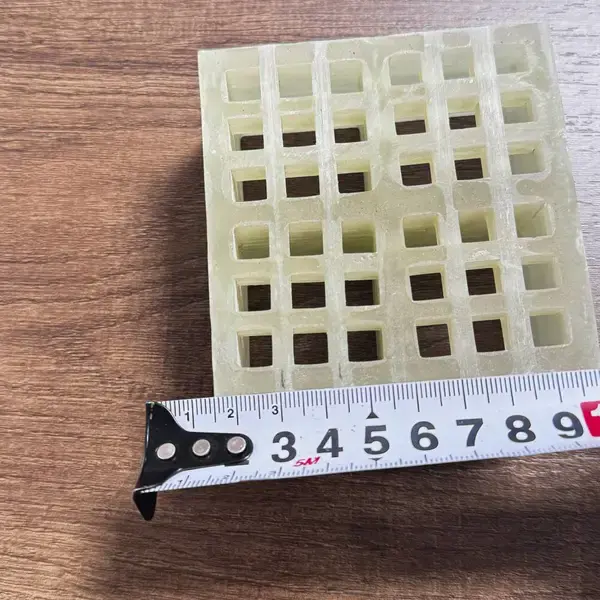
Heavy duty FRP grating thickness refers to the vertical dimension of the grating panel measured from the top bearing surface to the bottom of the bar. In molded FRP grating, this is the thickness of the individual bars that make up the grid. In pultruded FRP grating, the thickness refers to the depth of the load-bearing I-beam or T-beam profiles.
The thickness of FRP grating is fundamentally different from the thickness of solid materials like steel plate. FRP grating is an open-grid structure where the thickness determines the depth of the bearing bars that carry the load. A thicker bar provides greater moment of inertia, which translates directly into higher load capacity and reduced deflection.
Manufacturers produce heavy duty FRP grating in several standard thicknesses, with the most common being 1 inch (25 mm), 1.5 inches (38 mm), and 2 inches (50 mm). Each thickness serves a distinct range of applications:
- 1-inch (25 mm) grating — Suitable for light to moderate pedestrian traffic, mezzanine floors, and platforms with limited spans.
- 1.5-inch (38 mm) grating — The most widely used thickness for industrial flooring, walkways, and light vehicle traffic. Offers a strong balance between load capacity and material cost.
- 2-inch (50 mm) grating — True heavy duty grade designed for forklift traffic, heavy equipment platforms, bridge decks, and spans exceeding 4 feet.
Some manufacturers also offer custom thicknesses such as 1.25-inch (32 mm) and 2.5-inch (64 mm) for specialized requirements. The standard thickness for heavy duty FRP grating panels in most industrial settings is 1.5 inches, but the correct choice depends on the specific load requirements and support spacing of your project.
Standard Heavy Duty FRP Grating Thickness Options
Manufacturers produce heavy duty FRP grating in well-defined standard thicknesses. Understanding these options helps you narrow down choices quickly. Below is a detailed breakdown of each standard heavy duty FRP grating thickness option.
1-Inch (25 mm) Heavy Duty FRP Grating
- Typical applications: Catwalks, mezzanine flooring, light pedestrian platforms, decorative screening.
- Maximum recommended span: 18–24 inches (450–600 mm) for medium loads.
- Load capacity: Suitable for uniform loads up to 150–200 psf depending on resin type and bar spacing.
- Weight: Approximately 3.5–4.5 lbs/ft², making it the lightest heavy duty option.
- Advantages: Economical, easy to handle and install, lower material cost.
- Limitations: Limited span capability; not suitable for forklift or vehicular traffic.
1.5-Inch (38 mm) Heavy Duty FRP Grating
- Typical applications: Industrial walkways, platform flooring, trench covers, drainage grates, mezzanines.
- Maximum recommended span: 24–30 inches (600–750 mm) for medium loads; up to 18 inches for heavy loads.
- Load capacity: Handles uniform loads of 250–400 psf, sufficient for most industrial environments.
- Weight: Approximately 4.5–5.5 lbs/ft², a practical balance of strength and weight.
- Advantages: Industry standard thickness; wide availability; good stiffness-to-weight ratio.
- Limitations: May not be adequate for extreme heavy equipment or very wide spans.
2-Inch (50 mm) Heavy Duty FRP Grating
- Typical applications: Forklift aisles, loading docks, heavy equipment platforms, bridge decking, vehicle access roads.
- Maximum recommended span: 36–48 inches (900–1200 mm) for medium loads; 24–30 inches for heavy loads.
- Load capacity: Capable of uniform loads exceeding 500 psf; H-20 truck loading rating achievable with proper design.
- Weight: Approximately 6.5–8.0 lbs/ft², significantly heavier but dramatically stronger.
- Advantages: Maximum load capacity; longest span capability; suitable for vehicular traffic.
- Limitations: Higher material cost; heavier to transport and install; may require reinforced support structure.
In addition to these standard heavy duty FRP grating sizes, some manufacturers produce 1.25-inch (32 mm) and 2.5-inch (64 mm) panels for custom applications. Always consult load tables from the specific manufacturer, as actual capacity varies with resin formulation, glass content, and bar configuration.
Heavy Duty FRP Grating Thickness vs Load Capacity
The relationship between heavy duty FRP grating thickness vs load capacity is straightforward: thicker grating panels can support heavier loads over longer spans with less deflection. This section explains the engineering principles behind this relationship and provides practical guidance based on industry-standard load tables.
Load Capacity by Thickness
The load capacity of FRP grating increases exponentially with thickness, not linearly. This is because the moment of inertia of a rectangular beam increases with the cube of its depth. In practical terms, a 2-inch thick grating bar is approximately 8 times stiffer than a 1-inch bar of the same width, even though it is only twice as thick.
Here is a general comparison of uniform load capacities for molded FRP grating with standard bar spacing (1.5-inch center-to-center):
| Thickness | Light Duty (50 psf) | Medium Duty (150 psf) | Heavy Duty (300 psf) | Max Span (300 psf) |
|---|---|---|---|---|
| 1 inch (25 mm) | 36 in | 24 in | 12 in | 12 in |
| 1.5 inches (38 mm) | 48 in | 30 in | 18 in | 18 in |
| 2 inches (50 mm) | 60 in | 40 in | 24 in | 24 in |
Note: Values are approximate and based on typical molded FRP grating with 1.5-inch bar spacing using fire-retardant polyester resin. Always verify with the manufacturer\'s certified load tables for your specific product.
For heavy duty FRP grating load capacity in industrial flooring applications, the 1.5-inch thickness is the minimum recommended choice. It provides a safety factor of at least 2:1 for most pedestrian and light maintenance traffic scenarios.
Deflection and Stiffness at Different Thicknesses
Deflection — the amount a grating panel bends under load — is a critical design parameter. Industry standards typically limit deflection to 0.25 inches or L/200 (span divided by 200), whichever is less. Thicker grating panels deflect significantly less under the same load:
- 1-inch grating deflects approximately 0.35–0.50 inches at 24-inch span under 300 psf load.
- 1.5-inch grating deflects approximately 0.15–0.25 inches at 24-inch span under 300 psf load.
- 2-inch grating deflects approximately 0.08–0.12 inches at 24-inch span under 300 psf load.
If your application requires a firm, stable walking surface with minimal bounce, the thicker grating options provide noticeably better performance. This is particularly important when the grating is used for elevated platforms where workers are moving equipment or carrying heavy loads.
How to Choose the Right Thickness for Heavy Duty FRP Grating
Choosing the right panel depth requires careful evaluation of your specific operating conditions. Here is a practical decision framework to guide your selection of heavy duty FRP grating.
Industrial Flooring Applications
Different industrial environments impose different demands on FRP grating:
- Chemical processing plants: 1.5-inch depth with corrosion-resistant vinyl ester resin is standard. The panel thickness must account for potential chemical attack that could reduce the cross-section over time. A deeper grating provides additional corrosion allowance.
- Wastewater treatment facilities: 1.5-inch or 2-inch depth depending on access requirements. Areas with heavy equipment or sludge handling equipment typically require 2-inch panels.
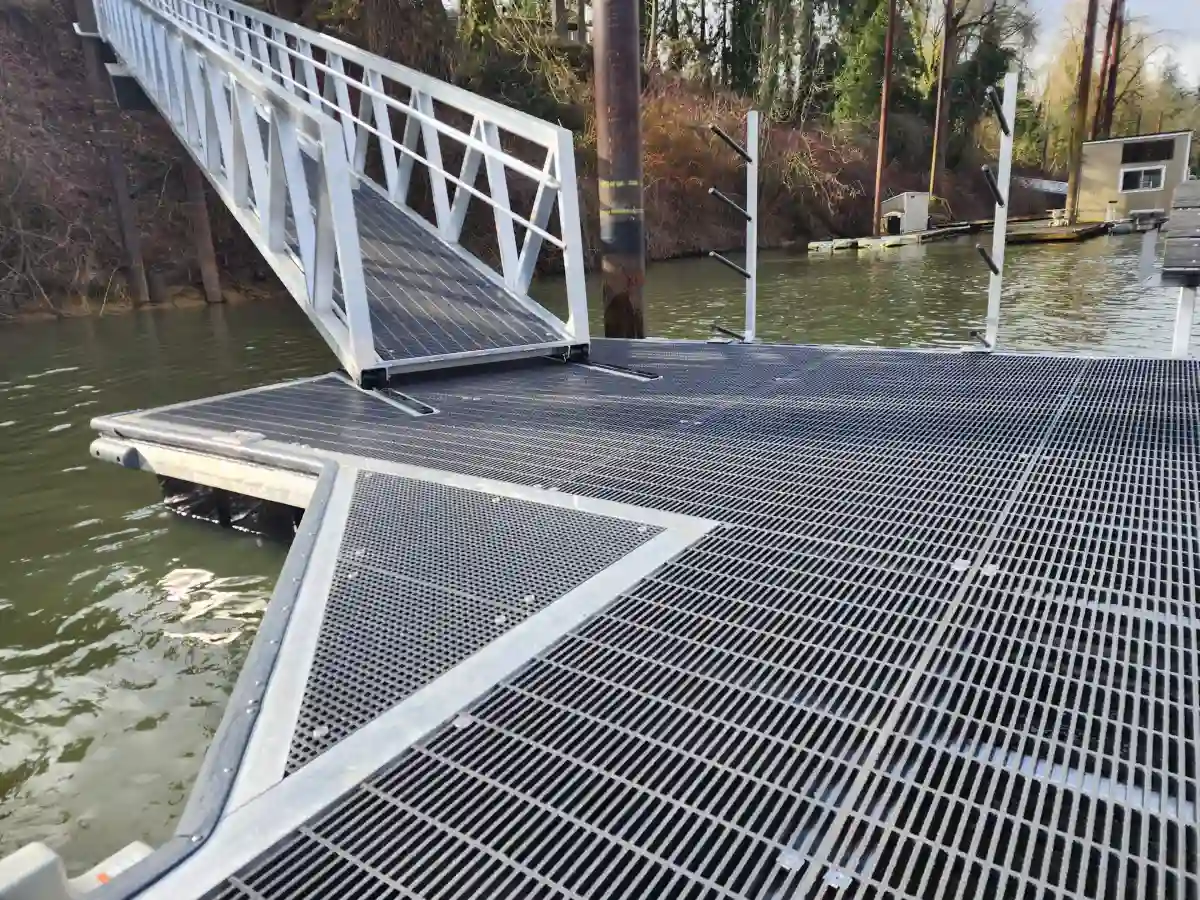
- Offshore platforms and marine environments: 2-inch depth is preferred due to high wind loads, wave action, and the need for maximum safety margins. The added weight of thicker grating is justified by the harsh operating conditions.
- Food processing and pharmaceutical facilities: 1-inch or 1.5-inch may be sufficient depending on traffic. The focus here is often on easy cleaning and slip resistance rather than extreme load capacity.
- Heavy equipment platforms: 2-inch minimum for any platform supporting machinery, generators, or forklifts. Always verify the point load capacity of the specific grating depth against your equipment's wheel or support loads.
Factors That Influence Thickness Selection
Beyond the application itself, several technical factors affect the optimal grating depth:
- Span length: The distance between support beams is the single most important factor. Longer spans require thicker panels. As a rule of thumb, the span in inches should not exceed 25 times the grating thickness in inches for safe operation.
- Uniform vs. concentrated loads: A grating that handles 300 psf uniform load may fail under a single 2,000 lb concentrated point load. If equipment will be placed on the grating, verify point load capacity specifically.
- Resin system: The resin used (polyester, vinyl ester, phenolic) affects the material strength. The same panel depth in a vinyl ester grating typically carries 10–15% less load than an equivalent polyester grating.
- Glass content and orientation: Higher glass content increases strength. Molded grating typically has 30–35% glass by weight, while pultruded grating can reach 50–60% glass. This means a pultruded 1.5-inch grating may outperform a molded 2-inch grating in some cases.
- Environmental conditions: High temperatures reduce FRP strength. At 150°F (65°C), FRP retains approximately 70–80% of its room temperature strength. If your environment is hot, consider stepping up one thickness grade.
- Safety factors: Industry standards recommend a safety factor of at least 2:1 for pedestrian traffic and 3:1 for critical applications. Deeper grating sections provide higher safety factors automatically.
The simplest approach: start with the required span length and expected load, consult the manufacturer's load table, and select the minimum grating depth that provides at least a 2:1 safety factor. Then consider corrosion allowance and temperature derating, and move up one thickness grade if either applies to your environment.
Heavy Duty FRP Grating Sizes and Panel Dimensions
Beyond thickness, the overall heavy duty FRP grating sizes and panel dimensions are important specification parameters. Heavy duty FRP grating panels are manufactured in standard dimensions that work across multiple thickness options.
Standard Panel Sizes:
- 4 ft x 8 ft (1220 mm x 2440 mm) — The most common panel size for molded grating. Available in 1-inch, 1.5-inch, and 2-inch thicknesses.
- 4 ft x 12 ft (1220 mm x 3660 mm) — Extended length panels for longer spans, typically in 1.5-inch and 2-inch thicknesses. Requires special handling during installation.
- 3 ft x 10 ft (915 mm x 3050 mm) — Alternative size for narrower walkways and platforms. Commonly used in 1.5-inch and 2-inch thicknesses.
- Custom cut sizes — Most manufacturers can cut panels to specific dimensions. Custom widths down to 6 inches are available for trench covers and narrow pathways.
Bar Spacing Configurations:
The spacing between bearing bars affects the effective load capacity of the grating. Standard configurations include:
- Heavy duty bar spacing (1-3/8 inch or 35 mm center-to-center): Maximum load capacity, minimum opening size. Standard for heavy duty industrial flooring where solids smaller than 0.75 inches could be a concern.
- Standard bar spacing (1.5 inch or 38 mm center-to-center): The most common configuration for general industrial use. Good balance between strength and open area.
- Light duty bar spacing (2 inch or 51 mm center-to-center): Higher open area for drainage and light transmission, but lower load capacity per thickness.
Square vs. Rectangular Mesh:
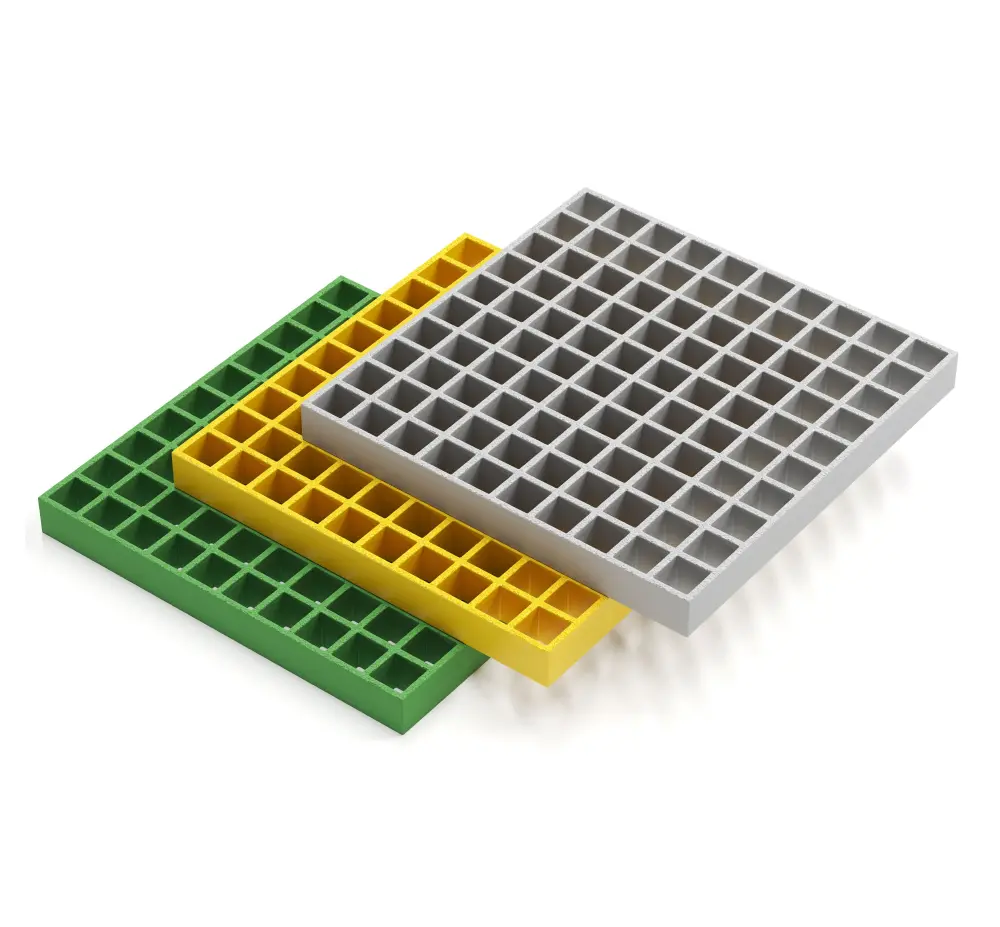
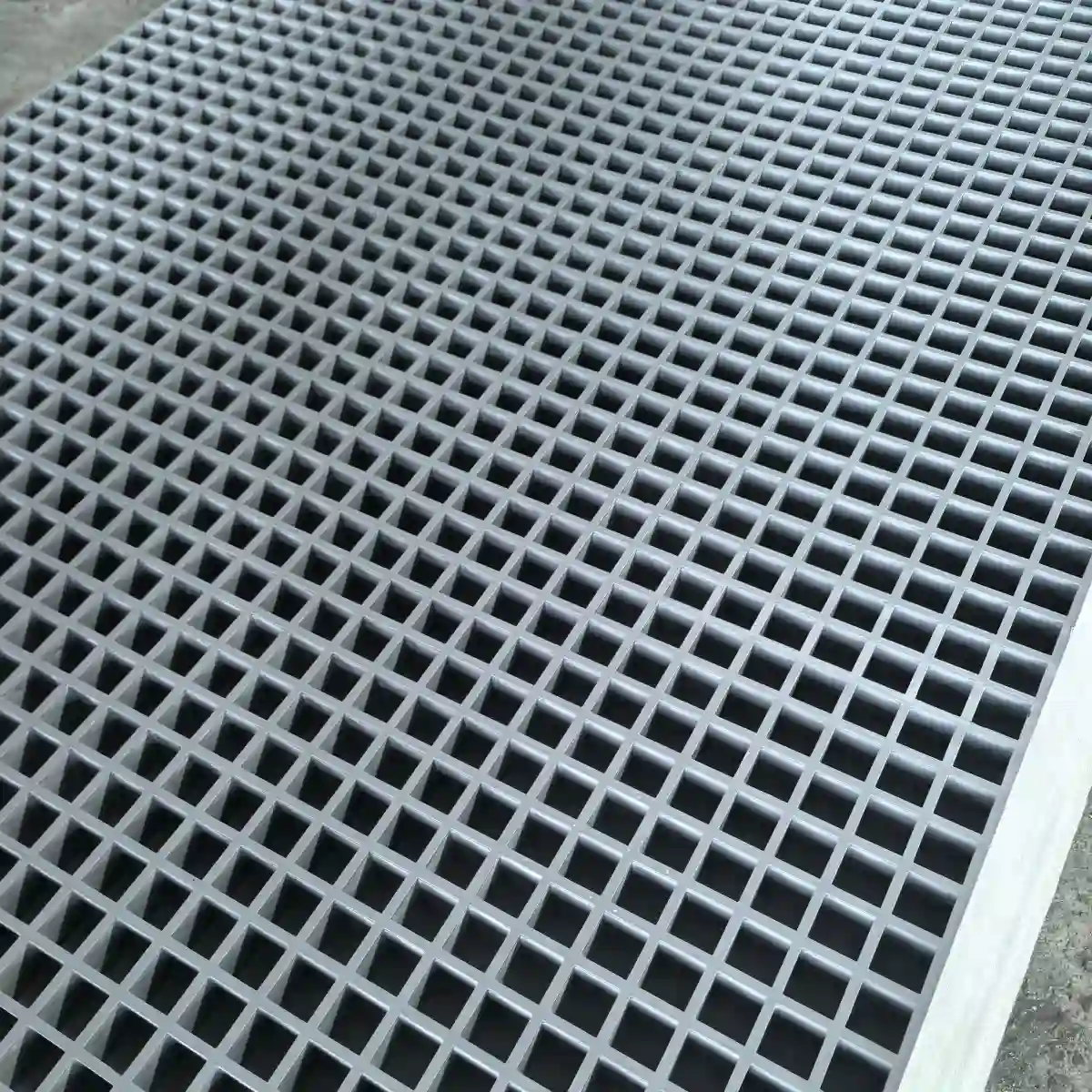
Molded FRP grating can be manufactured with either square or rectangular mesh patterns. Square mesh (same spacing in both directions) provides equal load capacity in both the length and width directions — useful for platforms where loads may come from any direction. Rectangular mesh has higher capacity in the length direction and is suitable for walkways where traffic direction is predictable.
When specifying heavy duty FRP grating sizes, consider the support structure layout. The bearing bars should always run perpendicular to the support beams for maximum load capacity. The thickness should be selected to match the support spacing after the basic panel size is determined.
How Thickness Affects Heavy Duty FRP Grating Weight
Understanding how heavy duty FRP grating thickness affects weight is important for structural design, shipping logistics, and installation planning. Here is what you need to know about the thickness-to-weight relationship.
Weight per Thickness:
| Thickness | Weight Range (lbs/ft²) | Weight of 4x8 Panel | Typical Resin Content |
|---|---|---|---|
| 1 inch (25 mm) | 3.5 – 4.5 | 112 – 144 lbs | 65–70% |
| 1.5 inches (38 mm) | 4.5 – 5.5 | 144 – 176 lbs | 65–70% |
| 2 inches (50 mm) | 6.5 – 8.0 | 208 – 256 lbs | 65–70% |
Key observations about weight:
- The weight increase from 1-inch to 1.5-inch is approximately 25–35%, while the load capacity increase is 50–100%. Thicker grating provides significantly more strength per pound than thinner grating.
- The weight increase from 1.5-inch to 2-inch is approximately 40–55%, and the load capacity increase is 75–150% depending on span and bar spacing.
- Despite being heavier, 2-inch grating often requires fewer support beams because it can span longer distances, potentially reducing the overall structural steel weight.
- FRP grating weighs approximately 70–80% less than steel grating of equivalent load capacity, even at the thickest options. This is one of the main advantages of specifying thick FRP grating over traditional steel solutions.
- Pultruded grating is typically 10–15% heavier than molded grating at the same thickness due to higher glass content, though it also provides proportionally higher strength.
When calculating support structure loads, always use the actual weight of the selected grating panel including any additional features such as grit top surface or integrally molded color coatings, which can add 0.2–0.5 lbs/ft² to the overall weight.
Minimum Thickness for Heavy Duty FRP Grating
A common question in project specification is the minimum grating depth that can be safely used for heavy duty applications. The answer depends on the specific use case, but general guidelines exist.
Minimum Thickness by Application:
- Light pedestrian walkways (mezzanines, catwalks): 1 inch (25 mm) is the practical minimum for any application supporting human traffic. Panels thinner than 1 inch are available but are classified as light duty and not suitable for heavy duty industrial use.
- General industrial flooring (platforms, walkways, trenches): 1.5 inches (38 mm) is the minimum recommended for applications that qualify as heavy duty. This is the most commonly specified minimum for industrial environments.
- Vehicle traffic (forklifts, trucks, heavy equipment): 2 inches (50 mm) is the absolute minimum. Some applications may require 2.5 inches (64 mm) or thicker depending on wheel loads and axle configurations.
- Bridge decking: 2 inches (50 mm) minimum, with many specifications requiring 2.5 inches (64 mm) or thicker for main spans.
Why minimum thickness matters:
- Safety compliance: OSHA and international standards require grating to support specified loads with adequate safety factors. Using the correct panel depth ensures compliance with relevant safety standards.
- Deflection control: Thinner panels can feel bouncy and unstable under foot traffic, even if they technically meet load requirements. Workers prefer a firm walking surface.
- Corrosion allowance: In corrosive environments, some material loss over time is inevitable. Specifying a deeper grating provides a corrosion allowance that maintains safe load capacity throughout the service life.
- Impact resistance: Thicker bars are more resistant to impact damage from dropped tools, equipment, and debris.
- Long-term durability: A deeper panel subjected to the same loads as a thinner one will experience lower stresses and fatigue, resulting in a longer service life.
For most industrial applications, we recommend 1.5 inches as the default minimum heavy duty FRP grating thickness. This provides a robust safety margin, comfortable walking surface, and long service life across a wide range of conditions. Only consider 1-inch grating for strictly light-duty pedestrian applications with closely spaced supports, and always step up to 2 inches for any application involving vehicles or heavy point loads.
Conclusion
Selecting the right grating depth is a critical engineering decision that affects safety, performance, and project cost. Here is a summary of the key takeaways from this guide on heavy duty FRP grating thickness:
| Thickness | Best For | Max Span (Heavy Load) | Relative Cost |
|---|---|---|---|
| 1 inch (25 mm) | Light pedestrian, catwalks, mezzanines | 12–18 in | $ |
| 1.5 inches (38 mm) | Industrial flooring, walkways, platforms | 18–24 in | $$ |
| 2 inches (50 mm) | Forklift, vehicle, heavy equipment | 24–36 in | $$$ |
Always follow these best practices when specifying grating depth:
- Start with the span length — this is the primary driver of thickness requirements.
- Determine the maximum expected load, including concentrated point loads from equipment.
- Consult certified load tables from your chosen manufacturer — do not rely on generic values.
- Apply appropriate safety factors (2:1 minimum for pedestrians, 3:1 for critical applications).
- Account for environmental factors: temperature, chemical exposure, and UV degradation.
- Consider future needs: will equipment be added later? Choose a depth that provides room for growth.
- Work with experienced FRP grating suppliers who can provide engineering support and certified design data.
The most commonly specified grating depth for general industrial use is 1.5 inches — it offers the best combination of strength, weight, cost, and availability. For demanding applications involving vehicle traffic or extreme loads, 2-inch panels provide the necessary safety margin and long-term durability. By understanding the relationship between thickness, load capacity, span, and weight, you can confidently select the right FRP grating for your project.