Introduction
When specifying industrial flooring, access platforms, or drainage covers, engineers and procurement professionals rely on one critical document: the FRP grating specification sheet. This technical document contains all the essential data needed to select, compare, and procure the right fiberglass reinforced plastic (FRP) grating for any application. Understanding how to read and interpret a specification sheet is fundamental to making informed purchasing decisions that balance safety, performance, and cost.
Unlike generic product brochures, this document provides verified engineering data — including material composition, dimensional tolerances, load capacity ratings, and compliance certifications. Whether you are designing a chemical plant walkway, a wastewater treatment platform, or a marine dock, the spec sheet is your primary reference for ensuring the grating meets project requirements.
This guide explains everything you need to know about specification sheets: what they contain, what industry standards they reference, how to read them step by step, and how to compare multiple sheets to choose the best product for your application.
What Is an FRP Grating Specification Sheet?
Definition and Purpose
An FRP grating specification sheet is a technical document published by manufacturers that details the physical, mechanical, and chemical properties of a specific grating product line. It serves as the official reference for engineers, contractors, and purchasing agents to verify that a grating product meets project specifications and applicable industry standards.
Who Uses Specification Sheets?
Specification sheets are used by multiple stakeholders throughout the project lifecycle:
- Structural engineers — verify load capacity and deflection limits for safe design
- Procurement teams — compare products from different suppliers on equal technical terms
- Safety inspectors — confirm fire rating, slip resistance, and corrosion resistance
- Installation contractors — reference panel dimensions, weight, and cutting guidelines
Why Specification Sheets Matter
A properly interpreted specification sheet prevents costly mistakes. Selecting a grating panel with insufficient load capacity can lead to structural failure; choosing the wrong resin system can result in rapid corrosion in chemical environments. The specification sheet eliminates guesswork by providing standardized, verifiable data. It also serves as a legally binding document — if a product fails to meet the values stated on its specification sheet, the manufacturer may be held liable for warranty claims or safety incidents.
Key Information Included in FRP Grating Specification Sheets
A specification sheet contains several categories of technical data. Understanding each category helps you quickly locate the information you need.
Material Composition and Resin System
This section specifies the type of fiberglass reinforcement (continuous strand mat, woven roving, or a combination) and the resin system used. Common resin systems include:
- Polyester resin — general-purpose, cost-effective for mild environments
- Vinyl ester resin — superior corrosion resistance for chemical processing
- Phenolic resin — low smoke and flame spread for fire-sensitive applications
The spec sheet will also note the glass content percentage, typically ranging from 30% to 50% by weight, which directly affects the panel strength.
Standard FRP Grating Dimensions
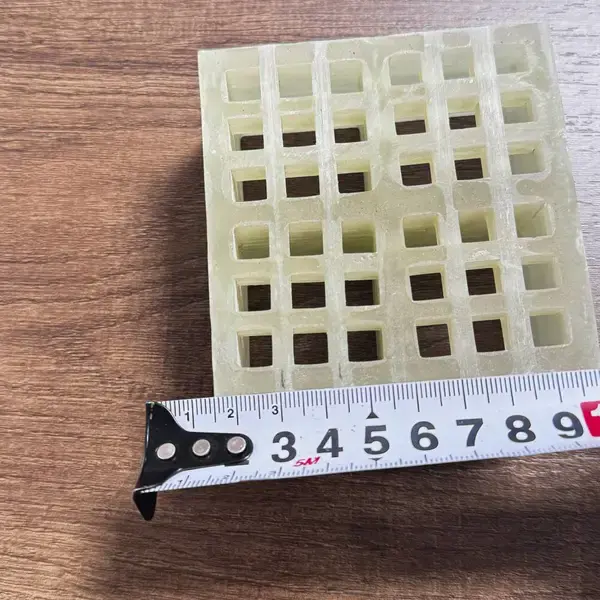
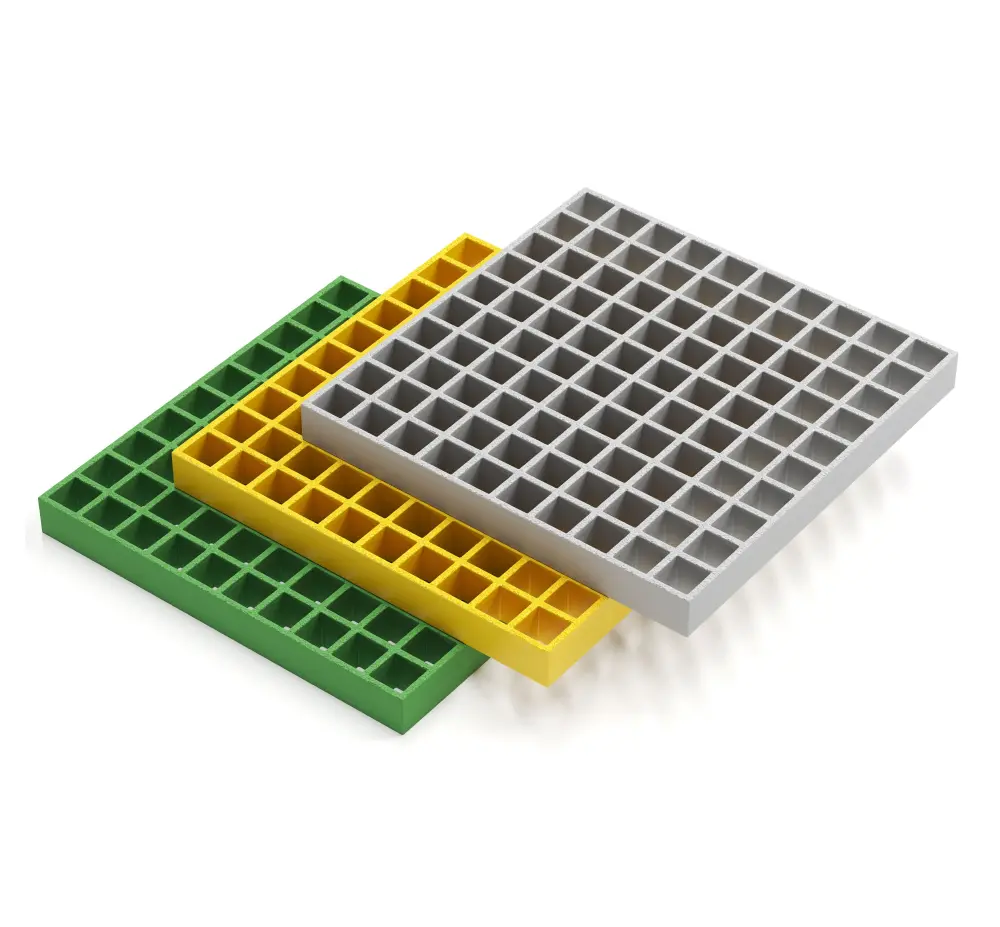
One of the most important sections covers standard FRP grating dimensions. Typical parameters include:
| Parameter | Typical Range | Common Values |
|---|---|---|
| Panel width | 24 in – 60 in (610 mm – 1524 mm) | 36 in, 48 in |
| Panel length | 96 in – 144 in (2438 mm – 3658 mm) | 96 in, 120 in |
| Panel thickness | 1 in – 2 in (25 mm – 50 mm) | 1 in, 1.5 in, 2 in |
| Mesh pattern | Square or rectangular openings | 1.5 in × 1.5 in, 2 in × 2 in |
| Bearing bar spacing | Center-to-center distance | 1-3/16 in, 1-9/16 in |
Always verify that the standard FRP grating dimensions listed on the sheet match your project drawings. Non-standard dimensions may require custom fabrication and longer lead times.
Load Capacity and Deflection Data
This is the most technically dense section of any FRP grating spec sheet. It typically presents load tables showing:
- Concentrated load capacity (lbs or kN applied over a defined area)
- Uniform load capacity (psf or kN/m² distributed across the panel)
- Deflection at various load levels (inches or mm)
- Safe working load after applying safety factors
Load tables are usually organized by panel thickness and span length. Some sheets include separate tables for different support conditions (simply supported, continuous span, or cantilevered).
Safety Factors and Standards Compliance
The specification sheet will state the safety factor used in load calculations. Common safety factors include 1.5× for static loads and 2.0×–3.0× for dynamic or pedestrian loads. The sheet also lists the applicable standards against which the product was tested, ensuring compliance with local building codes.
Industry Standards Listed on FRP Grating Specification Sheets
A reliable FRP grating specification sheet always references the industry standards under which the product was tested and certified. These standards provide a common benchmark for comparing products from different manufacturers. The most commonly referenced standards include:
| Standard | Title | What It Specifies |
|---|---|---|
| ASTM E84 | Standard Test Method for Surface Burning Characteristics of Building Materials | Flame spread index and smoke developed index (Class A, B, or C rating) |
| ASTM D635 | Standard Test Method for Rate of Burning and/or Extent and Time of Burning of Plastics | Horizontal burning rate for self-extinguishing properties |
| ASTM C581 | Standard Practice for Determining Chemical Resistance of Thermosetting Resins | Long-term chemical exposure performance |
| OSHA 1910.23 | Walking-Working Surfaces Standard | Slip resistance, load requirements, and guardrail specifications |
| ANSI/NAAMM FG 1-20 | Fiberglass Grating Manual | Standardized load tables, deflection criteria, and design guidelines |
| ISO 9001 | Quality Management Systems | Manufacturing quality consistency (not product-specific but indicates quality control) |
When reviewing a specification sheet, always check which edition of each standard is referenced — newer editions may have updated test methods or stricter requirements. Some manufacturers also include IBC (International Building Code) compliance certifications for seismic and wind load applications.
Understanding what each standard means helps you quickly assess whether a grating product is suitable for your specific application environment. For example, a chemical plant would prioritize ASTM C581 chemical resistance data, while a public building would focus on ASTM E84 flame spread classification.
How to Read an FRP Grating Specification Sheet
Reading a specification sheet can be intimidating at first due to the density of technical data. However, by following a systematic approach, you can quickly extract the information you need. Here is a step-by-step method for reading any FRP grating spec sheet.
Step 1: Identify the Product and Resin System
Start at the top of the sheet. The product name, series number, and resin type should be clearly stated. This immediately tells you whether the grating is suitable for your environment. For example, a sheet labeled "Vinyl Ester Heavy-Duty Grating — 1.5 in Thickness" indicates a corrosion-resistant product designed for industrial loads.
Step 2: Review the Standard FRP Grating Dimensions
Check the panel dimensions section. Confirm that the width, length, and thickness match your project requirements. Pay special attention to bearing bar spacing and mesh configuration — these affect both load capacity and open area percentage (important for light transmission and drainage).
Step 3: Locate the Load Table for Your Span
Load tables are typically organized by support span. Find the row corresponding to your span length and read across to find the maximum safe load and corresponding deflection. Most specification sheets present data for concentrated loads (a point load, e.g., a forklift wheel) and uniform loads (distributed weight, e.g., stored materials).
Step 4: Apply the Safety Factor
The load values in the table are often ultimate (failure) loads. Multiply by the stated safety factor to determine the working load. For example, if the ultimate load is 1,000 lbs at a 24-inch span and the safety factor is 1.5, the safe working load is 667 lbs.
Step 5: Check Compliance and Certifications
Scan the footer or notes section for third-party certifications and standard references. Look for flame spread classification (Class A, B, or C per ASTM E84), chemical resistance test results, and any jurisdiction-specific approvals.
Step 6: Note Special Conditions
Many specification sheets include footnotes about test conditions — temperature, support conditions, load application method, and moisture content. These conditions may differ from your actual installation environment, so adjust your expectations accordingly.
How to Compare FRP Grating Using Specification Sheets
One of the most valuable uses of an FRP grating specification sheet is comparing products from different manufacturers. When you have multiple sheets in front of you, comparing them systematically ensures you select the best product for your application without being swayed by marketing claims.
Establishing an Apples-to-Apples Comparison
Before comparing, normalize the data. Make sure all sheets use the same units, the same test standards, and the same safety factors. Some manufacturers list ultimate loads while others list allowable working loads — comparing them directly could lead to dangerous overestimates of capacity.
Key Parameters to Compare
Focus on these parameters when comparing FRP grating using specification sheets:
- Load capacity at equal span — Compare the load rating at the same span length (e.g., 24-inch span for both products)
- Deflection at working load — Stiffer panels may be preferred for pedestrian comfort and safety
- Resin system and corrosion resistance — Verify chemical compatibility for the specific environment
- Fire rating — Class A (flame spread 0–25) is required for most building interiors
- Weight per square foot — Heavier panels may need stronger support structures
- Panel dimensions and open area — Affects installation efficiency and drainage performance
Using Comparison Tables
Create a side-by-side comparison table listing the critical parameters from each specification sheet. This makes differences immediately visible. For example, one manufacturer might offer a 1.5-inch thick panel with 800 lbs concentrated load capacity at a 24-inch span, while another offers only 650 lbs for the same thickness and span — a significant difference that directly impacts safety margins.
Watch Out for Missing Data
A complete specification sheet should include all major data categories. If a manufacturer omits key information — such as chemical resistance data or fire rating — treat it as a red flag. Reputable manufacturers test their products thoroughly and provide comprehensive specification data.
Cost per Performance, Not Cost per Panel
When comparing prices alongside specification sheets, calculate cost per unit of load capacity rather than cost per square foot. A panel with higher load capacity may cost more per square foot but require fewer supports, resulting in lower total installed cost.
Where to Find FRP Grating Specification Sheets
Knowing where to find reliable FRP grating specification sheets is essential for engineers and procurement professionals. Here are the most common sources:
Manufacturer Websites
Most major FRP grating manufacturers host their specification sheets in the "Resources," "Technical Library," or "Downloads" sections of their websites. These are typically available as downloadable PDFs. Leading manufacturers include:
- Strongwell (Duradek, Safe-T-Span product lines)
- Bedford Reinforced Plastics
- Fibergrate (now part of McNeilus)
- Krahn GFRP Grating
- Composites One distribution network
Engineering Specification Portals
Platforms like ARCAT, SpecSource, and 4Specs aggregate specification sheets from multiple manufacturers in a standardized format. These are particularly useful for architects and spec writers who need to create project specifications consistent with MasterFormat sections.
Request from Suppliers Directly
If you are working with a distributor or fabricator, request the most current specification sheet directly from their technical sales team. This ensures you have the latest revision — manufacturers occasionally update load tables or resin formulations without widely publicizing the changes.
Industry Organizations
The NAAMM (National Association of Architectural Metal Manufacturers) publishes the Fiberglass Grating Manual (ANSI/NAAMM FG 1-20), which includes standard specification templates. While not product-specific, this manual provides the framework for understanding what a complete specification sheet should contain. It is an excellent reference for verifying that a manufacturer's sheet covers all necessary data points.
CAD and BIM Libraries
Some manufacturers now embed specification data directly into BIM (Building Information Modeling) objects and CAD blocks. This allows engineers to pull dimensional and performance data directly into their design software, reducing manual data entry errors.
Conclusion
The FRP grating specification sheet is the most important tool you have for selecting the right fiberglass grating product. It transforms complex engineering data into a standardized, comparable format that empowers informed decision-making. By understanding what each section of the specification sheet means — from material composition and standard FRP grating dimensions to load tables, safety factors, and industry standards — you can confidently specify grating that meets your project's exact requirements.
Whether you are a structural engineer designing a new platform, a procurement manager evaluating supplier bids, or a safety engineer verifying compliance, mastering this document saves time, reduces risk, and ensures the grating you select performs as expected for decades.
Always request the latest specification sheet directly from the manufacturer before making a final purchase. Compare multiple sheets side by side, verify test standards and certification dates, and never hesitate to ask the manufacturer for clarification on any data point. A well-understood specification sheet is your guarantee of quality, safety, and performance.
Need help interpreting a specification sheet? Contact our technical team for assistance with product selection, load calculations, and project specification review.